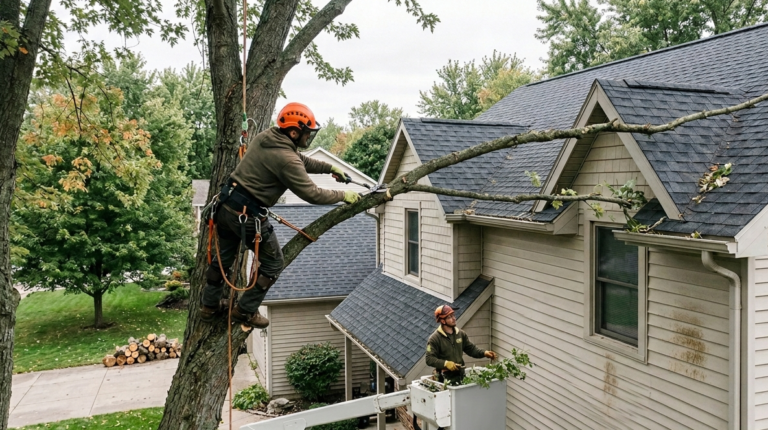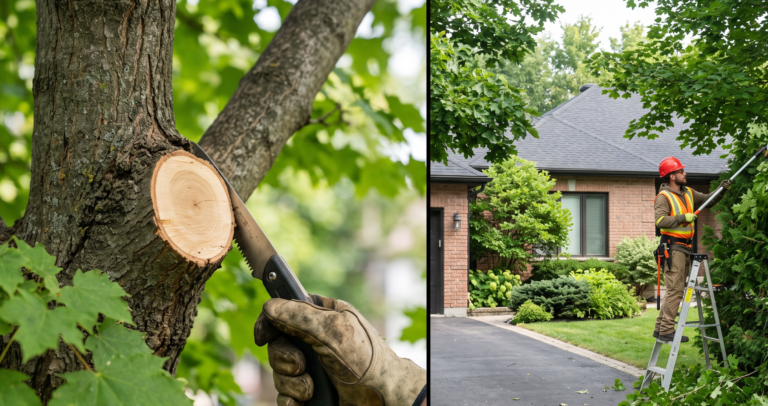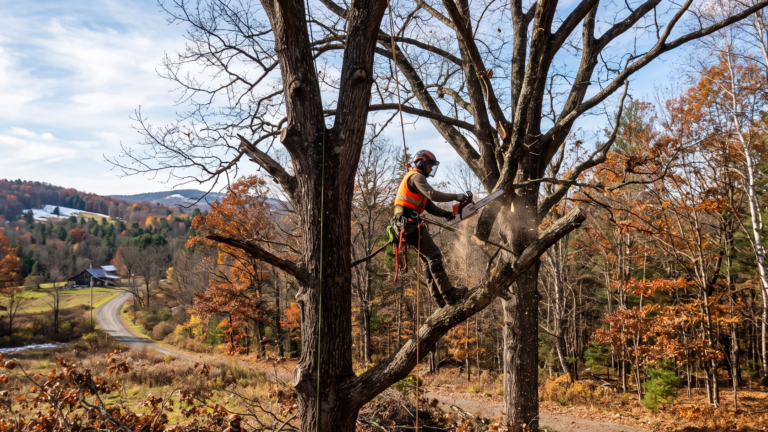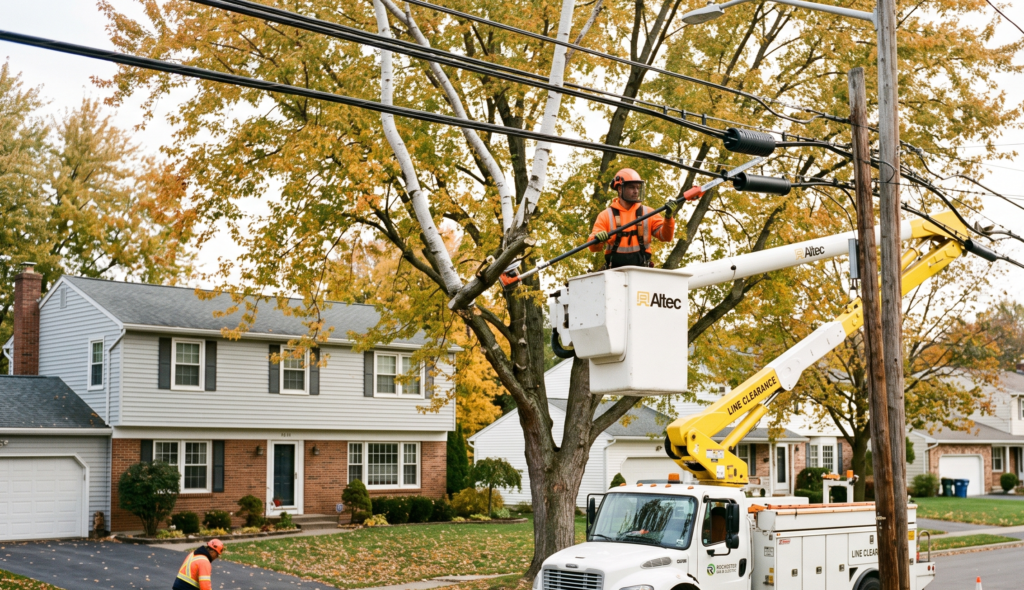
When mature silver maples, dense oaks, or towering pines start encroaching on energized utility wires, scheduling tree removal near power lines becomes an urgent safety priority for any property owner in Rochester, NY. Along the Genesee River basin, Lake Ontario shoreline, and dense suburban corridors throughout Monroe County, severe lake-effect snowstorms, freezing ice loads, and sudden summer squalls routinely force heavy limbs into live electrical infrastructure. Attempting to prune or cut down branches near utility corridors without specialized dielectric equipment risks fatal electrocution, structural damage to your home’s electric weatherhead mast, and neighborhood-wide circuit trips. Navigating this challenge safely requires recognizing the specific overhead lines on your land, understanding where utility maintenance mandates end, and knowing when to call a qualified, line-clearance certified tree service.
Why Trees and Overhead Utility Lines Are a Lethal Combination
A tree branch resting motionless against an electric wire can give a false sense of security. In reality, working around electrical utility corridors introduces critical physical and electrical hazards that standard residential pruning techniques cannot mitigate.
- Arcing and Direct Electrocution: Electrical current does not require physical touch to escape a conductor. High distribution voltage can ionize surrounding air and jump (“arc”) several feet directly to a pruning pole, ladder, branch, or climber.
- Moisture Conductivity in Living Wood: Although dry timber is an electrical resistor, living trees contain mineral-dense sap, groundwater, and surface moisture. Under thousands of volts of distribution pressure, a green limb acts as a high-voltage electrical conductor.
- Ground Step Potential: If a snapped wire or energized limb touches wet ground, current radiates outward through the soil in concentric voltage rings. The difference in electrical potential between where your feet stand can bridge thousands of volts straight through your legs and heart—a fatal phenomenon known as step potential.
- Dynamic Stored Tension: Limbs woven through overhead lines carry unpredictable mechanical tension. Cutting a limb under strain can snap conductors, bend utility crossarms, or trigger a violent “barber-chair” trunk split that throws the saw operator into live wires.
Frequently Asked Questions
Can a tree catch fire just by touching an electrical wire in Rochester?
Yes. Sustained branch friction and electrical tracking create severe localized resistance. The sap boils, internal wood carbonizes, and the branch ignites into open flame that can drop embers onto roofs or lawns below.
Can I safely use a fiberglass pole pruner near power lines?
No. Off-the-shelf consumer fiberglass tools are not dielectric-tested safety gear. Dirt, sap residue, morning condensation, or humidity transforms standard pole tools into dangerous conductors under distribution-level voltage.
Identifying Your Lines: Transmission, Distribution, or Service Drop?
Before planning any limb clearance, identify the specific types of overhead cables crossing your parcel. Voltage capacity, maintenance ownership, and emergency protocols differ across each layer of the electrical infrastructure.
| Line Classification | Visual Identification & Placement | Voltage Range | Legal Maintenance Responsibility | Required Homeowner Action |
| Transmission Lines | Giant steel towers or massive wood structures on cleared cross-country corridors. | 69,000V – 765,000V+ | Regional Grid Operator (RG&E / NYSEG / National Grid) | Stay away. Report vegetative right-of-way incursions directly to the power company. |
| Primary Distribution Lines | Highest wires mounted on crossarms or porcelain insulators on roadside utility poles. | 2,400V – 34,500V | Electric Utility Provider | Utility manages clearance. Certified line-clearance arborists handle adjacent felling. |
| Secondary Distribution Lines | Middle cables feeding from local transformers down neighborhood streets. | 120V – 240V | Electric Utility Provider | Maintained by utility vegetation management to prevent neighborhood service blackouts. |
| Service Drop (Lateral) | The overhead line extending from the street pole directly to your home’s roofline weatherhead. | 120V – 240V | Private Property Owner | Property owner must hire an insured, line-clearance qualified private tree service. |
| Telecommunication Wires | Lowest bundled black cables on the pole (broadband, telephone, cable TV). | Less than 50V | Telecom Carrier / Property Owner | Low nominal voltage, but life-threatening if a snapped power wire contacts them upstream. |
Frequently Asked Questions
How do I distinguish the electrical service drop from cable television or internet lines?
Follow the path of the wire to your house. The electrical service drop feeds into a vertical metal pipe mast (the weatherhead) that drops into your exterior electric meter. Cable TV and fiber lines fasten lower on exterior siding and enter through small junction boxes.
Are low-hanging telecom cables safe to handle when cutting tree limbs?
Never assume any line is inert. During windstorms or limb breakages, a high-voltage primary wire up the road can snap and drape over telecom cables, energizing the entire line silently without tripping circuit breakers.
The Responsibility Breakdown: Who Pays and Who Cuts in Rochester?
Homeowners often ask: “Will the electric utility take down this dangerous tree for free?” The answer hinges on whether the hazard threatens the public grid or private electrical lines.
1. The Utility Company Right-of-Way (ROW)
Utility providers across the Greater Rochester area, such as Rochester Gas & Electric (RG&E), operate under utility regulatory requirements to safeguard regional grid stability.
- High-Voltage Primary Corridors: Utilities monitor and maintain tree clearances along transmission paths and primary distribution wires.
- Utility Trimming Standards: Utility vegetation contractors prune strictly for clearance, not aesthetics. Trimming frequently results in deep directional “V” cuts or “side cuts” to maintain an unobstructed 10-to-15-foot buffer around conductors.
- Debris Left Behind: When a utility cuts down or limbs a hazardous tree on private property to safeguard main lines, their crews routinely leave the cut wood, logs, and mulch on site. Cleaning up the remaining timber falls to the property owner.
2. The Private Service Drop: Homeowner Responsibility
The electrical line spanning from the municipal street pole across your front yard to your meter socket belongs to your private service configuration.
- No Routine Utility Trimming: Rochester-area utilities do not conduct routine preventative tree pruning along private service drops. Protecting that run from rubbing or falling limbs is the property owner’s legal and financial responsibility.
- Owner Repairs: If a dying tree splits and tears the service drop down, the utility will disconnect power at the pole for safety, but they will not rebuild your home’s torn weatherhead, meter box, or fascia board. You must pay a licensed electrician to rebuild the mast before the utility will reattach power.
- Proactive Removal: Taking down a rotting or leaning tree near an overhead service line requires contracting a private tree service holding line-clearance credentials.
Frequently Asked Questions
Does the electric company cut down dead trees that lean toward my garage or driveway?
No. If the tree’s fall path does not threaten high-voltage primary distribution or transmission lines, the utility classifies the tree as private property liability and requires the homeowner to handle it.
Can RG&E prune branches on my private property without asking?
Yes. Within designated legal utility right-of-way easements, utility companies possess statutory authority to prune or remove vegetation that presents a clear danger to the operational power grid without individual landowner permission.
Step-by-Step: What to Do If a Tree Is Close to Power Lines
If you identify severe lean, extensive fungal decay, or cracked structural limbs hovering over electrical wires in Rochester, use this action sequence:
- Perform a Safe Ground-Level Inspection: Keep a minimum buffer of 30 to 50 feet. Look for limb contact, scuffed black insulation, sparking, or brown foliage indicating active electrical leakage.
- Determine Urgency: If a branch has snapped and is resting on a line, or if you hear buzzing and see smoke, immediately evacuate the yard and dial 911 along with the emergency utility line.
- Schedule a Temporary Service Disconnection: For planned tree work near your service drop, contact your electric utility to request a planned “disconnect and reconnect.” The utility drops the wire to the lawn on the scheduled morning, allowing your private tree care team to dismantle the tree without live voltage overhead, and returns in the afternoon to reconnect service.
- Hire an ISA-Certified, Line-Clearance Qualified Tree Service: Ensure the contracted arborist uses dielectric-tested aerial buckets, non-conductive synthetic rigging, and crane-assisted dismantle techniques.
Frequently Asked Questions
Does a temporary power shutoff for tree removal cost money in Rochester?
Most municipal electric utilities provide scheduled temporary service disconnect/reconnect appointments for residential tree work at little to no charge, since proactive hazard mitigation prevents costly emergency outage repairs.
What should I do if a tree branch falls on a power line during a storm?
Never touch the tree, fence lines, or vehicles parked nearby. Evacuate the area, keep pets and neighbors at least 30 feet back, and immediately call 911 and your power company’s emergency line.
What Never to Do: Crucial Homeowner Safety Rules
- Never use aluminum or uninsulated ladders near overhead lines. Aluminum conducts current instantly, and even wooden or fiberglass ladders conduct electricity when damp or coated in fine debris.
- Never use pole saws, pruners, or chainsaws within 10 feet of a wire. The risk of electrostatic arcing or unexpected branch deflection is severe.
- Never climb a tree that is intertwined with overhead cables. A slight weight shift can flex branches into conductors or bridge voltage directly through the trunk into your body.
- Never attempt to pull fallen limbs off wires using ropes. Braided ropes absorb airborne moisture, transforming synthetic and hemp cords into direct conductive paths.
- Never let children climb trees near service drops. Inspect your yard regularly to confirm that treehouses, swings, and climbing limbs remain well clear of all incoming overhead wires.
Frequently Asked Questions
What is OSHA’s 10-foot rule for overhead power lines?
OSHA Standard 29 CFR 1910.269 and ANSI Z133 regulations dictate that non-qualified workers and conductive equipment maintain a strict safety buffer of at least 10 feet from overhead electrical conductors. Only qualified line-clearance arborists may operate within that boundary.
Is it safe to rake or clean up brush directly underneath a utility line?
Ground cleanup is safe only if branches are completely severed, fully on the ground, detached from all wires, and no sagging cables hang low enough to touch personnel or equipment.
Choosing the Right Tree Removal Professional
Dismantling large trees in utility corridors requires specialized technical rigging, directional sectional lowering, and strict safety adherence. Before hiring a contractor, confirm they possess:
- Line-Clearance Certification: Formal verification that working crews comply with OSHA Standard 29 CFR 1910.269 and ANSI Z133 tree care electrical safety standards.
- ISA-Certified Arborists on Staff: Arborists credentialed by the International Society of Arboriculture understand wood physics, species-specific failure rates, and crane rigging load limits.
- Direct Insurance Certificates: Active Commercial General Liability and Workers’ Compensation coverage sent directly from the insurance broker to your email address (never rely on verbal claims or photocopies).
- Dielectric Aerial Booms & Cranes: Modern non-conductive aerial lifts tested under ANSI A92.2 standards, paired with grapple cranes that lift out heavy wood sections vertically without impacting utility lines.
Frequently Asked Questions
Why can’t my regular landscaping or lawn service trim trees near power lines?
Standard landscaping services do not carry dielectric-certified bucket trucks or OSHA 1910.269 line-clearance credentials. Their general business liability policies explicitly exclude electrical utility hazard work.
What happens if an uninsured contractor damages the power line on my property?
If an unqualified, uninsured contractor pulls down utility cables or snaps a transformer, the property owner can be held liable by the utility company and neighbors for repair costs, equipment replacement, and related damages.
Finding Certified Hazardous Tree Removal Near Me: Rochester, NY
When severe lake-effect snowstorms, high wind gusts off Lake Ontario, or heavy ice storms threaten to bring down trees onto utility lines, searching for a dependable tree service near me in Rochester, NY demands proven local responsiveness. Proximity matters: having insulated aerial equipment and crane crews based directly in Monroe County ensures fast emergency response before leaning timber causes electrical mast damage or prolonged power outages.
From our local base at 91 Mason Ave in Rochester, NY (14626), Greece Tree Service provides certified hazardous tree removal, crane-assisted sectional dismantling, and 24/7 storm damage clearance. Whether your property is situated near Lake Avenue, Dewey Avenue, Long Pond Road, Mt. Read Boulevard, Ridge Road, or along the Lake Ontario State Parkway, our line-clearance qualified crews arrive on site with dielectric bucket trucks, heavy rigging gear, and full commercial insurance protection.
- Core Operational Base: 91 Mason Ave, Rochester, NY 14626
- Monroe County Service Areas: Rochester, Greece, Irondequoit, Gates, Hilton, Charlotte, Spencerport, and Henrietta
- Local Utility Integration: Complete operational familiarity with RG&E (Rochester Gas & Electric) disconnect/reconnect coordination protocols
Frequently Asked Questions
How fast can an arborist inspect a dangerous tree near my power line in Rochester?
Non-emergency evaluations are usually completed within 24 to 48 hours. If high winds or ice storms cause an active limb failure threatening your service drop, our 24/7 emergency dispatch mobilizes immediately across the Greater Rochester area.
Do I need a city or town permit to remove a tree near wires in Rochester, NY?
Private residential tree removals on private property generally do not require municipal permits unless the tree is situated within a dedicated municipal right-of-way, conservation easement, or historic preservation district. Our estimators review local municipal requirements during your on-site assessment.
How can I get an estimate for hazardous tree removal near power lines?
You can request an estimate online by uploading photos of the tree and power lines, or schedule a free on-site safety evaluation with an ISA-certified arborist to assess drop clearances and utility requirements.
Protect Your Home and Power Grid Today
Do not wait for winter lake-effect snow or severe summer gusts to drop an overgrown limb through your home’s electrical service line. Removing hazardous trees within utility zones requires verified credentials, heavy rigging equipment, and strict adherence to electrical safety protocols.
Contact Greece Tree Service today to schedule an on-site hazardous tree evaluation in Rochester, NY. Our team coordinates line-clearance procedures, executes precision dismantling, and ensures your home, property, and power connection remain secure.