Dealing with an unsightly tree stump in the middle of your yard is frustrating, especially when you are trying to mow the lawn, plan a new patio, or keep your family from tripping over exposed roots. If you are researching stump grinding in Rochester, NY, one of the first questions that probably crosses your mind is whether you can rent a machine from a local hardware store and knock the job out over a weekend or if you are better off bringing in an experienced crew. On the surface, renting a compact grinder seems like an easy way to save a few hundred dollars. Once you look closer at the hidden costs, physical demands, underground utility risks, and the realities of Western New York soil, the decision becomes much clearer.
At Greece Tree Service, our ISA-certified arborists and field crews handle residential and commercial stump projects across Monroe County every single week. From our yard on Mason Avenue, we have seen homeowners successfully tackle tiny ornamental stumps on their own, and we have also been called in to rescue plenty of weekend projects where a rental machine got stuck, broke a blade on buried glacial rock, or barely scratched the surface of a massive silver maple root flare.
In this guide, we will walk through an honest, side-by-side look at DIY stump grinding versus hiring a professional service so you can make the smartest, safest, and most cost-effective choice for your property.
Understanding What Stump Grinding Actually Involves
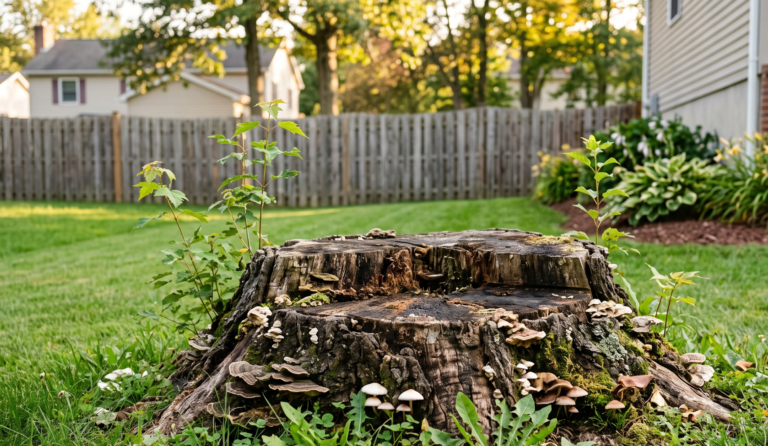
Before deciding who should do the work, it helps to understand what happens beneath the grass line. Many homeowners confuse stump grinding with full stump removal. While full excavation pulls the entire root ball out of the earth—leaving a massive crater that requires heavy backfill—grinding uses a high-speed rotating cutting wheel fitted with tungsten-carbide teeth to shave the wood down into fine mulch chips.
A proper grind does not just shave the stump flush with the turf. If you only take the wood down to ground level, you will never be able to establish healthy grass over that spot, and aggressive local species like willow, poplar, or silver maple will continue sending up nuisance shoots. To reclaim your yard properly, the stump and its major surface root flares need to be ground 6 to 12 inches below grade (and even deeper if you plan to pour concrete, install pavers, or plant a new tree in the same footprint).
Frequently Asked Questions
How deep should a tree stump be ground below the soil line?
For standard lawn restoration where you plan to spread topsoil and plant grass seed, grinding 6 to 8 inches below grade provides enough soil depth for healthy turf roots to establish without drying out. If you plan to build a deck footing, pour a concrete driveway, or plant a replacement tree in the same spot, the wood should be ground 12 to 18 inches deep.
Will grinding a stump kill the entire root system so the tree stops sprouting?
Yes, when done properly. Grinding destroys the main crown and upper root flares where dormant buds live. While deeper feeder roots remain underground, they are cut off from sunlight and oxygen and will naturally decompose over several years without sending up new suckers.
The Realities of DIY Stump Grinding
If you have a small, shallow-rooted stump—say, an old crabapple or a decorative birch under 10 inches in diameter—and you are comfortable operating heavy outdoor power equipment, doing it yourself is physically possible. However, most homeowners underestimate what a DIY rental day actually entails.
1. Rental Machines Are Underpowered for Mature Trees
The stump grinders available at big-box home improvement stores and local tool rental yards in the Rochester area are typically lightweight, walk-behind units powered by 13-horsepower engines. They are designed to be light enough for one or two people to load onto a utility trailer.
While a 13 HP walk-behind unit can chew through a soft pine stump in an hour or two, mature hardwoods common across Greece, Gates, Irondequoit, and Spencerport—such as red oak, sugar maple, ash, and black walnut—have dense, interlocking grain. Grinding a 28-inch hardwood stump with a small rental machine can take four to six hours of grueling, back-straining physical labor. You have to manually sweep the cutter head side to side, muscle the machine forward an inch at a time, and constantly fight vibrations that leave your arms and shoulders sore for days.
2. The Hidden Costs Add Up Quickly
When people compare quotes, they often look strictly at the four-hour rental rate on a store’s website. Once you factor in every expense required to get the job done, the savings shrink dramatically:
- Machine Rental & Damage Waiver: A four-hour or full-day rental typically runs between $150 and $300 once mandatory damage protection fees and sales tax are added.
- Transportation: Unless you already own a pickup truck with heavy-duty loading ramps or a low-deck utility trailer, you will need to rent a truck or trailer to haul a 250- to 400-pound machine home and back before the clock runs out.
- Fuel and Blade Fees: Most rental centers require you to return the tank full of non-ethanol fuel, and many charge extra if you dull or snap carbide teeth on hidden stones.
- Safety Gear: You cannot safely run a grinder in sneakers and regular sunglasses. You need heavy-duty eye protection, a full-face mesh shield, hearing protection, thick leather gloves, and steel-toe boots.
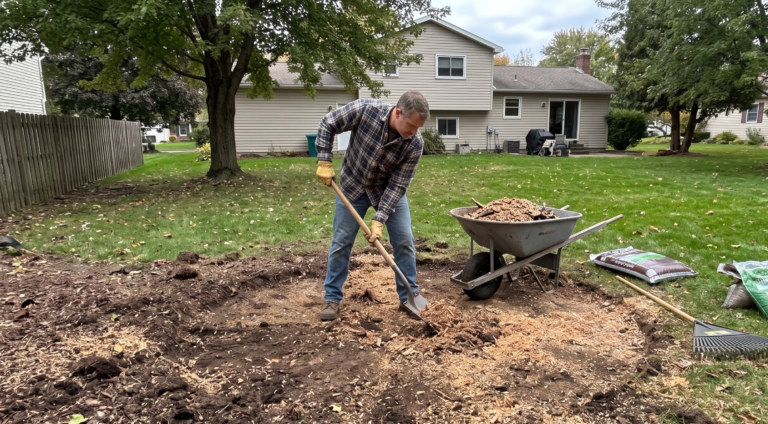
- Cleanup Tools and Hauling: A single large stump produces a surprisingly massive mountain of wood chips mixed with soil. You will spend additional hours raking, wheelbarrowing, and finding a legal way to dispose of the excess mulch, plus buying topsoil and grass seed to level the hole.
3. Safety Hazards and Flying Debris
A stump grinder is essentially an exposed, high-RPM circular saw spinning inches from your feet. Because the cutting wheel operates at ground level, it frequently catches buried rocks, old fencing wire, brick fragments, and dense knots of wood, launching them outward at lethal speeds. Even commercial operators use heavy plywood blast shields to keep projectiles from shattering house windows, sliding glass doors, or parked car windshields. Without experience controlling the sweep speed and bite depth, a rental grinder can also kick back violently if the wheel catches a thick root too aggressively.
Frequently Asked Questions
Can I transport a rental stump grinder in the back of a standard SUV or minivan?
No. Even compact walk-behind stump grinders weigh between 250 and 450 pounds, leak fuel or hydraulic fluid if tipped, and have sharp exposed cutting teeth. You need an open pickup truck bed with rated loading ramps or a low-bed utility trailer with a drop gate.
What happens if I break a cutting tooth on a rental machine?
Most rental agreements include a wear-and-tear clause or charge per broken carbide tooth—typically $15 to $35 per tooth—if you hit rocks, concrete, or metal. Even with a damage waiver, gross negligence or severe wheel damage can result in costly repair bills.
Why Western New York Yards Present Unique Challenges
Working outdoors in Monroe County comes with a few regional quirks that make DIY grinding trickier than watching a five-minute tutorial video online:
- Glacial Till and Buried Rocks: Because our region was shaped by glaciers, soils in neighborhoods from North Greece down toward Chili and Henrietta are notoriously packed with cobbles and stones. Tree roots naturally grow around these rocks over decades. Hitting a fist-sized granite cobble at full throttle will instantly shatter carbide teeth on a rental unit, halting your project and costing you extra in repair fees.
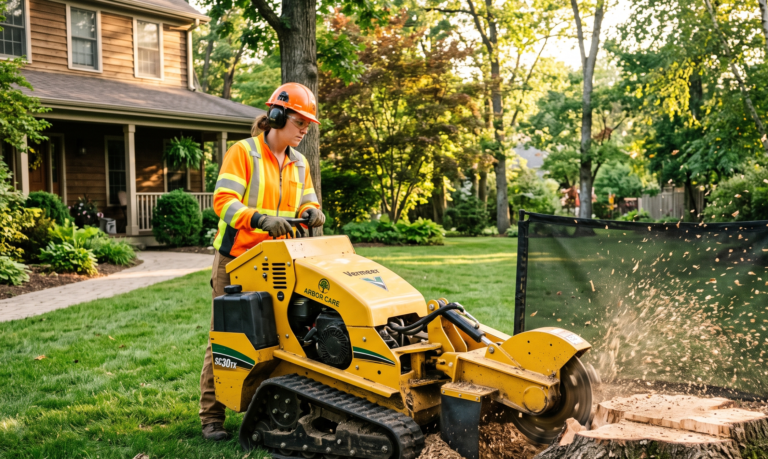
- Heavy Clay and High Water Tables: Close to Lake Ontario and along local creeks, heavy clay soils hold moisture well into late spring and autumn. Lightweight wheeled rental grinders easily sink, rut up your lawn, and lose traction in damp turf, whereas commercial self-propelled track grinders distribute their weight evenly across wide rubber tracks so your lawn stays intact.
- Dense Neighborhood Layouts: In established neighborhoods near Latta Road, Dewey Avenue, or West Ridge Road, yards are often fenced with narrow 36-inch side gates, tight property lines, and nearby sheds or gardens. Maneuvering an awkward walk-behind machine without damaging fence posts or siding takes practiced control.
Frequently Asked Questions
What is the best time of year to have a stump ground in Rochester?
Stump grinding can be done year-round as long as the ground is not frozen solid under deep snowpack. Late spring, summer, and fall offer ideal conditions, though professional track machines can safely navigate damp spring and autumn lawns across Monroe County without sinking into clay soil.
Can commercial grinders fit through a standard backyard gate?
Yes. While massive tow-behind grinders require wide driveway access, professional tree services use specialized self-propelled track grinders that retract to 35 or 36 inches wide, allowing them to pass cleanly through standard residential side gates without removing fence panels.
Underground Utilities: The Risk You Cannot Afford to Ignore
Before anyone—homeowner or contractor—puts a cutting wheel into the ground in New York State, underground utilities must be located. Over the years, tree roots wrap tightly around shallow service lines, including:
- Natural gas service lines
- Buried electrical feeds to garages, pools, or outdoor lighting
- Fiber-optic internet and cable lines
- Sprinkler and irrigation piping
- Municipal water laterals
In New York, you are legally required to contact UDig NY (dial 811) at least two full business days before digging or grinding. Even after utility flags are placed, public locators only mark main public lines up to the meter—they do not mark private lines like pool heaters, invisible dog fences, or lawn irrigation systems. An experienced local arborist knows how to read utility markings, identify subtle clues around your meter boxes, and carefully work around shallow roots without severing a line that could cost thousands of dollars to repair or put your family in danger.
Frequently Asked Questions
Do I really need to call 811 if I am only grinding 6 inches deep?
Yes. Cable, fiber-optic, sprinkler, and even older residential gas or electric lines frequently sit just 4 to 8 inches below the surface—especially when tree roots have heaved the soil upward over the decades. Calling 811 is free and required by New York State law before any mechanical excavation or grinding.
Who calls UDig NY (811)—me or the tree service?
When you hire a reputable professional tree service, the company handles the 811 utility mark-out request on your behalf before scheduling your crew. You should only let the crew know about private underground lines (such as invisible pet fences, pool plumbing, or yard lighting wires) that public locators do not mark.
DIY vs. Hiring a Pro: Side-by-Side Comparison
To help you weigh both options at a glance, here is how a typical weekend DIY rental compares against hiring an insured local tree care company:
| Factor | DIY Rental Grinder | Professional Stump Grinding Service |
| Equipment Power | 13–25 HP walk-behind wheeled unit | 35–75+ HP hydraulic track-driven commercial grinder |
| Time Required | 4 to 8+ hours (including pickup, grinding, cleanup, and return) | 30 to 90 minutes on site |
| Grinding Depth | Usually 4–6 inches (limited by machine reach and operator fatigue) | 8–12+ inches below grade, including surface flare roots |
| Lawn Protection | Narrow tires can rut wet grass; it’s hard to steer on slopes. | Wide low-ground-pressure rubber tracks protect turf. |
| Insurance & Liability | The homeowner assumes all risk for property damage and personal injury. | Backed by full commercial liability and workers’ compensation insurance |
| Cleanup & Restoration | You rake, haul chips, and source topsoil on your own | Complete chip management, leveling, and optional topsoil/seeding |
| Total Out-of-Pocket Cost | 200–400+ after rental, trailer, fuel, and safety gear | Typically 150–450, depending on diameter, species, and access |
When you tally up the rental fees, trailer expenses, fuel, and an entire Saturday of exhausting physical work, hiring a professional crew often costs nearly the same—and sometimes less—than doing it yourself.
Frequently Asked Questions
How do tree care companies calculate the cost of stump grinding?
Most professionals price jobs based on the widest diameter of the stump measured at ground level (including root flares), the wood species (hardwoods take longer than softwoods), accessibility, and the total number of stumps on the property.
How long does a professional crew take to grind an average stump?
With a high-horsepower hydraulic track machine, an experienced operator can typically grind a standard 20- to 24-inch hardwood stump, chase surface roots, and level the chips in 30 to 60 minutes.
When DIY Makes Sense vs. When to Call a Professional
We always believe in giving homeowners straightforward, honest advice rather than pushing a service they do not need. Here is a simple rule of thumb to guide your decision:
DIY Might Work If:
- You have one small stump (under 10 inches across) from a softwood or ornamental shrub.
- The stump sits in a wide-open area far away from windows, fences, driveways, and utility meters.
- You already own a pickup truck or trailer, have heavy-duty PPE, and genuinely enjoy strenuous outdoor equipment projects.
You Should Hire a Professional If:
- The stump is 12 inches or wider or comes from a dense hardwood like oak, maple, hickory, or ash.
- You have multiple stumps across your property (professionals offer significant multi-stump discounts because the truck and crew are already mobilized).
- The stump is close to your house foundation, driveway, sidewalk, underground utilities, or a neighbor’s fence.
- Access to your backyard requires fitting through a standard residential gate (our specialized narrow-access track machines fit through 36-inch gates effortlessly).
- You want to replant grass, install a patio, or put in a new garden bed and need the roots ground deep enough to prevent sinkholes later.
Frequently Asked Questions
Can I use the leftover stump grindings as garden mulch?
Stump grindings are a mix of shredded wood and soil. While you can use them around mature trees or along natural wooded borders, fresh wood chips temporarily tie up nitrogen as they decompose—so avoid mixing them directly into vegetable beds or delicate flower borders without composting them first.
How soon can I plant grass or a new tree where the stump used to be?
You can rake out the wood chips, backfill with screened topsoil, and sow grass seed immediately after grinding. If you want to plant a new tree, it is best to shift the planting spot 3 to 5 feet away from the old stump center so the new root ball has fresh, undisturbed soil to grow into.
What to Look for When Hiring a Local Stump Grinding Company
If you decide that hiring a pro is the safer, smarter move, take a few minutes to vet the company before letting heavy machinery onto your lawn:
- Verify Full Insurance Coverage: Always ask for proof of both general liability insurance (which covers your home, windows, and underground lines) and workers’ compensation coverage. Never hire an uninsured operator working out of the back of a pickup truck—if someone gets hurt on your property, your homeowner’s policy could be on the hook.
- Look for ISA-Certified Arborists: Credentials from the International Society of Arboriculture (ISA) and accreditation from the Tree Care Industry Association (TCIA) show that a company follows strict industry safety standards and understands tree root biology, not just how to run a machine.
- Ask About Grinding Depth and Cleanup: Clarify ahead of time how many inches below grade the crew will grind, whether they will chase major surface roots radiating out into your lawn, and whether they leave the wood chips neatly mounded or haul them away.
- Confirm UDig NY (811) Utility Marking: A reputable contractor will never skip utility mark-outs. They will coordinate with 811 before arriving so your gas, electric, and fiber lines stay protected.
Frequently Asked Questions
Why does workers’ compensation insurance matter for a quick stump job?
Stump grinding involves high-speed cutting wheels and heavy machinery. If a contractor lacks workers’ compensation coverage and an employee is injured on your property, you as the homeowner can be held financially liable for medical bills and lost wages. Always request a current certificate of insurance.
Should I have my stump ground at the same time as tree removal?
Bundling tree removal and stump grinding together is almost always the most economical choice. Because the crew and trucks are already at your home, companies typically offer a lower combined rate than scheduling a separate mobilization later.
Finding Reliable Stump Grinding Near You in Rochester & Monroe County
When homeowners search for “stump grinding near me“ after a storm or tree removal, response time and local equipment access matter just as much as price. Because our trucks and commercial track grinders are dispatched directly from our yard on Mason Avenue in Greece, our crew is already minutes away from neighborhoods across Greater Rochester—meaning you never pay extra travel surcharges or wait weeks for an out-of-town contractor.
We provide fast, fully insured residential and commercial stump grinding near you across
- Greece & North Greece: Latta Road, Dewey Avenue, Long Pond Road, and neighborhoods near Braddock Bay and Lake Ontario
- Westside Suburbs: Gates, Spencerport, Ogden, Chili, and North Chili
- City of Rochester: Charlotte, Maplewood, Browncroft, Park Avenue, and Highland Park
- Eastside & South Suburbs: Irondequoit, Webster, Penfield, Brighton, and Henrietta
Whether you need a single backyard stump cleared before installing a fence or multiple hardwood stumps ground down for a full yard renovation, our local crew brings the right narrow-access track machine directly to your property.
Frequently Asked Questions
How quickly can a local crew come out for stump grinding near me in Monroe County?
Because we operate locally out of Greece, NY, most estimates are completed within 24 to 48 hours, and standard residential stump grinding jobs are typically scheduled within the same week—even faster if you are bundling stump grinding with active tree removal.
Do you charge extra travel fees for suburbs outside the Town of Greece?
No. All communities within our primary Monroe County service radius—including Rochester, Gates, Irondequoit, Spencerport, Chili, Webster, and Henrietta—receive straightforward, flat-rate pricing with zero hidden mileage fees.
Reclaim Your Yard Safely with Greece Tree Service
Whether you are staring down a stubborn oak stump left over from a storm or clearing space for a backyard renovation, you do not have to risk your back—or your property—wrestling with an underpowered rental machine. Based right here on Mason Avenue in Rochester, Greece Tree Service brings commercial-grade track grinders, ISA-certified expertise, and full insurance protection directly to your yard.
Ready to get that eyesore out of your lawn for good? Call Greece Tree Service today at (585) 628-8744 or visit greecetreeservice.com to request your free, no-obligation estimate.