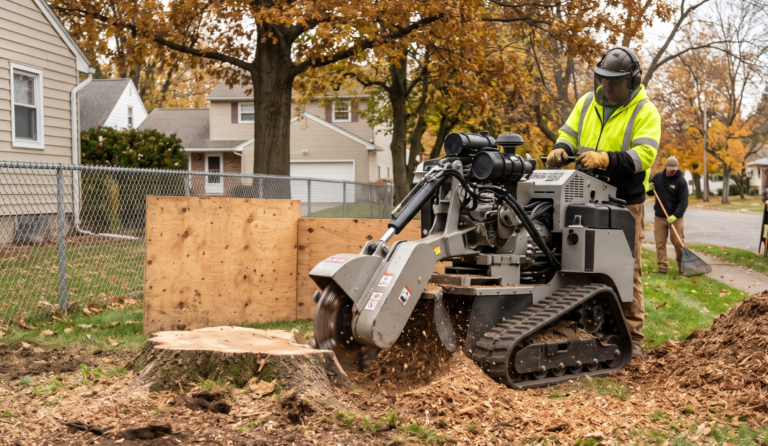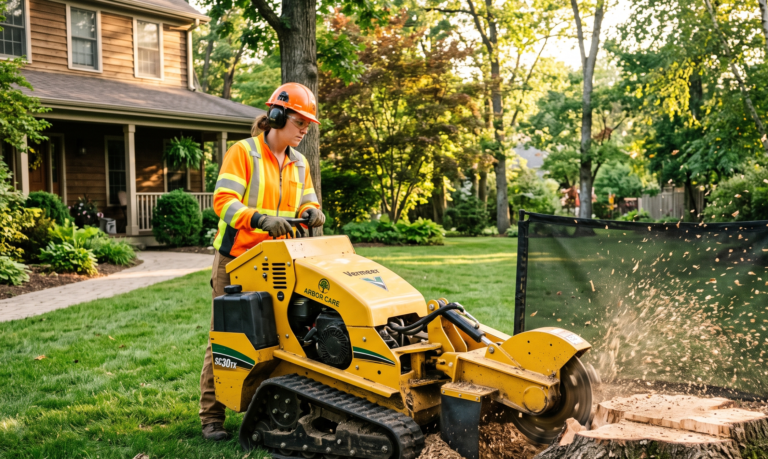
When you finally schedule professional stump grinding in Rochester, NY, watching an unsightly, hazardous tree stump disappear below the surface of your lawn brings immediate relief. Whether you just cut down an aging silver maple off Ridge Road, cleared storm-damaged limbs near Lake Ontario, or removed an overgrown spruce in Irondequoit, grinding that remnant flat transforms your outdoor living space. However, once the equipment pulls away, many property owners are left staring at a wide, shallow crater filled with mounds of fresh wood shavings, loose sawdust, and churned topsoil. If you expect to scatter a handful of Kentucky bluegrass seed or plant perennial shrubs directly into that spot next weekend, you are likely in for an unwelcome surprise: seed that fails to germinate, seedlings that turn pale yellow and die, or ornamental shrubs that choke from nitrogen deficiency.
Restoring the footprint of an old tree requires an understanding of what actually happens beneath the soil after mechanical grinding. Transforming that barren, wood-packed depression into lush turfgrass or a flourishing garden bed takes proper site cleanup, soil remediation, structural settling management, and planting tailored to Monroe County’s distinct climate and heavy clay-loam ground.
What Happens Below Ground After a Stump Is Ground Down?
To plant successfully over a ground-down area, you first have to understand the biological and structural reality of the site. Many homeowners assume that once the surface stump is gone, the ground is instantly ready for roots. In reality, stump grinding is a mechanical pulverization process, not an excavation.
1. The Carbon-to-Nitrogen Imbalance (Nitrogen Lockout)
Fresh wood chips, sawdust, and shredded bark are exceptionally high in carbon, often bearing a Carbon-to-Nitrogen ratio greater than 200:1 to 400:1. Beneficial soil microbes require nitrogen to metabolize and break down carbon. When vast quantities of raw wood grindings remain buried in the soil:
- Soil bacteria draw every available molecule of free nitrogen out of the surrounding root zone to decompose the wood.
- This process, called nitrogen drawdown or nitrogen immobilization, starves tender grass seedlings, perennial flowers, and vegetable roots of the vital macronutrient they need for cell division and chlorophyll production.
- Leaves turn chlorotic (pale yellow), root structures stall, and young plantings wither even if you water them daily.
2. Physical Subsidence and the “Sinkhole” Effect
A standard arborist grind chews the stump down between 6 and 12 inches beneath the existing grade. Beneath and around that excavated pocket, large structural root flares remain. Over the following 2 to 5 years, subterranean wood naturally decays due to native fungi and insects.
- As this underground biomass rots and collapses, soil particles shift downward.
- If you plant or seed over uncompacted, wood-rich fill immediately without establishing a firm base, the area will sink several inches, creating a dangerous depression, a tripping hazard, and a pooling basin for rainwater.
3. Soil Compaction and Drainage Stagnation
Grinder wheel traffic, coupled with heavy clay content common in Rochester suburban soils (from Greece and Irondequoit to Chili and Webster), packs the bottom of the grinding pit into a dense, impervious pan. When filled with sponge-like wood chips that hold excess moisture against raw soil, the area turns anaerobic, rotting tender new plant roots rather than letting them breathe.
Frequently Asked Questions
Why can’t I just cover the wood chips with topsoil and seed right away?
Covering raw chips traps a high-carbon barrier right below the seedbed. Soil microbes will pull every ounce of nitrogen away from the surface roots to break down the wood, starving new seedlings and leaving you with yellow, stunted patches.
How deep under the soil do decaying tree roots actually go?
While the grinding machine takes out the core 6 to 12 inches down, lateral anchor roots can extend 2 to 4 feet deep and spread well past the drip line, decaying slowly over several years.
Why does water puddle over my ground stump area after heavy rain?
The heavy weight of commercial machinery compresses Monroe County’s native clay base, creating an impermeable bowl. Uncompacted wood chips inside that bowl act like a sponge, holding standing water and suffocating new roots.
Step-by-Step: Restoring the Ground for a Flawless Lawn
If your goal is an even, seamless green lawn that blends perfectly with the rest of your turf, follow this comprehensive site preparation and seeding sequence.
Step 1: Excavate the Wood Chip Mound
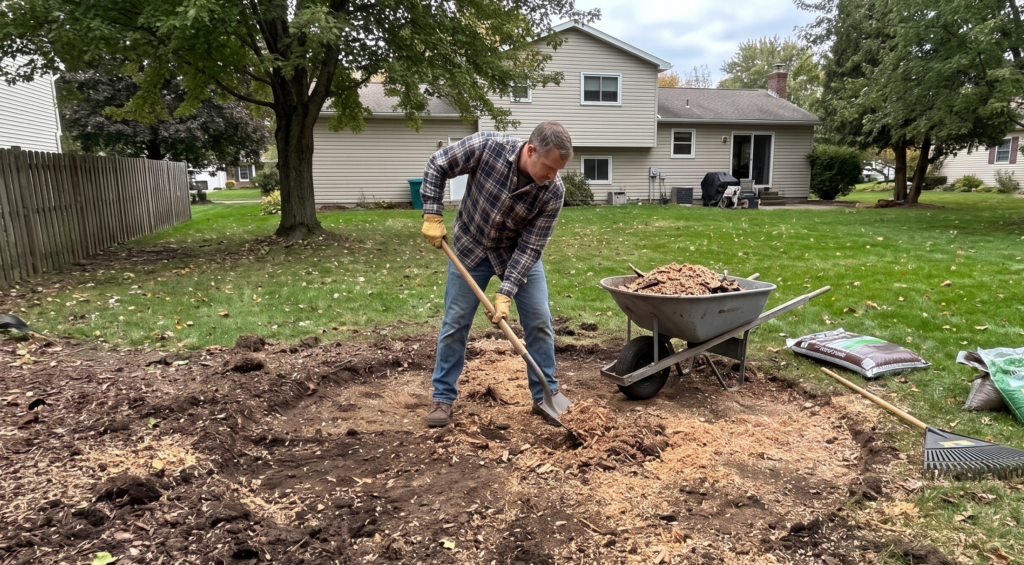
Do not leave the grinding mound in place. Grab a sturdy round-point shovel, a stiff landscape rake, and a wheelbarrow.
- Dig out at least 80% to 90% of the wood shavings and sawdust churned into the central depression.
- Work down until you expose native mineral soil or the firm sub-base, typically 4 to 6 inches below the surrounding lawn grade.
- What to do with the chips: Do not throw them away. Heap them in a back corner to age for 6 to 12 months into excellent compost, or use them as top-dress mulch in established landscape borders and tree rings well away from building foundations.
Step 2: Fracture the Sub-Base and Trace Radial Roots
Before adding clean soil, take a garden digging fork or pick mattock and strike the bottom and edges of the pit.
- Break up the glazed, compressed soil left by the grinder wheel.
- Check for high, shallow surface roots running out into your lawn. If thick lateral roots are exposed within 2 inches of the surface, notch or chisel down any protruding high points so your mower blade will never clip them.
Step 3: Amend and Backfill with High-Grade Topsoil
Fill the excavated basin with a nutrient-balanced soil mix designed to offset any remaining subterranean carbon.
- The Mixture: Blend roughly 60% high-quality screened sandy loam and 40% dark, mature organic compost or well-aged manure.
- The Elevation Buffer: Fill the hole until it crowns 1 to 2 inches higher than the surrounding lawn surface. Natural settling will occur as rain washes fine particles into voids between remaining deep roots; crowning prevents a noticeable dip later.
Step 4: Firm the Bed (Eliminate Deep Air Pockets)
Walk over the freshly placed topsoil using flat footsteps, or roll it with a half-filled water roller.
- You want the surface firm enough that a shoe leaves only a faint sole impression (roughly 1/4 inch deep), but not packed so hard that delicate root hairs cannot penetrate.
- Rake the top half-inch smooth with an aluminum garden rake, removing small stones, stray bark fragments, and clumps.
Step 5: Select the Right Cool-Season Turfgrass Seed
Rochester experiences freezing lake-effect winters, humid summers, and wet, cool transition periods. Cheap annual grasses will wither under summer stress. Choose an elite, certified cool-season seed blend suited to Western New York:
- Sunny Lawns: A durable blend of 60% Kentucky Bluegrass (Poa pratensis), 20% Turf-Type Tall Fescue, and 20% Perennial Ryegrass.
- Shaded/Canopy Areas: A mix dominated by fine fescues (creeping red fescue, hard fescue, and chewings fescue) that naturally tolerate tree cover and lower light levels.
- Application Rate: Spread the seed uniformly at 6 to 8 pounds per 1,000 square feet for bare ground repairs. Lightly scratch the surface with the back of a bow rake to achieve an optimal seed-to-soil depth of roughly 1/8 to 1/4 inch.
Step 6: Apply Starter Fertilizer and Clean Cover
- Apply a balanced starter fertilizer featuring an elevated phosphorus ratio (for instance, an N-P-K formulation like 10-18-10 or 12-24-8) along with slow-release nitrogen. The phosphorus drives deep, rapid root development, while nitrogen helps counteract any lingering carbon drawdown from subsurface wood debris.
- Cover the patch with a thin, uniform blanket of clean, weed-free wheat straw, chopped straw blankets, or seed mulch pellets. The ground should still be roughly 40% visible through the cover. This protects vulnerable seeds from drying winds, prevents bird theft, and stops downpours from washing the seed across your lawn.
Step 7: Maintain Consistent Moisture
Water is the single most critical variable over the first 21 days:
- Days 1 to 14: Mist or light-cycle irrigate 2 to 3 times daily for 5 to 10 minutes, keeping the top half-inch moist at all times. Do not create standing water or rivulets.
- Days 15 to 28: As germination takes hold and seedlings reach 1.5 inches, dial back watering frequency to once every other day, soaking deeper to encourage roots to dig down into your new topsoil base.
- First Mow: Wait until the new grass stands at 3.5 to 4 inches tall. Ensure your mower blade is razor-sharp, set the deck to 3 inches, and avoid sharp pivoting turns directly over the new turf.
Frequently Asked Questions
What is the best time of year to reseed over a stump in Rochester?
Late summer to early fall (mid-August through late September) is the sweet spot. Soil temperatures are warm, rain is consistent, and weed competition drops, giving cool-season blends time to establish before freezing weather arrives.
When can I mow over the newly planted stump site?
Wait until the new turf reaches roughly 3.5 to 4 inches in height. Cut it back to 3 inches with a clean, sharp mower blade, and avoid turning your mower wheels sharply on the tender patch.
Why did my new grass turn yellow a month after sprouting?
This is classic nitrogen deficiency caused by buried wood fragments. Apply a light top-dressing of slow-release nitrogen fertilizer to replenish what the decomposing wood pulled from the soil.
Transforming the Stump Area into a Beautiful Garden Bed
Turning a ground stump location into an ornamental planting island, perennial garden, or shrub border is often easier and more forgiving than growing flat turf. Instead of fighting minor natural settling, you can turn a former stump site into a contoured, elevated planting feature that hides structural voids beneath.
| Factor | Turfgrass Restoration | Ornamental Garden Bed |
| Site Profile | Must be level with the surrounding lawn; high vulnerability to settling dips | An elevated berm or framed mound naturally hides subgrade settling. |
| Wood Debris Tolerance | Extremely low; requires removing 80%-90% of raw shavings | Moderate; some chips can be pushed to outer edges or aged as mulch. |
| Rooting Depth Need | Shallow (2″-4″ root zone), but sensitive to drought & compaction | Varied; deep-root shrubs must be offset; perennials root easily in topsoil. |
| Fertilizer Strategy | High phosphorus starter fertilizer + balanced nitrogen top-dress | Balanced compost + balanced organic plant food (e.g., 5-5-5 or bone meal) |
| Visual Integration | Requires matching color, blade texture, and mowing height of lawn | Standalone design feature bordered with natural stone, brick, or edging |
Building a Raised Berm Over the Stump Zone
Rather than digging down deep into lingering subterranean root plates, the best landscaping method is building an elevated planting berm or raised garden bed directly over the site:
- Edge the Perimeter: Mark out a curvilinear or geometric perimeter around the old stump crater using a garden hose or marking paint, extending 2 to 3 feet past the original root flare.
- Excavate Surface Debris: Remove the top 4 to 6 inches of loose wood grindings.
- Mound Structural Soil: Deposit a generous blend of garden topsoil, coarse sand, and organic leaf compost to build a raised mound 8 to 12 inches high in the center, tapering gently toward the edges.
- Retain the Edges: Border the bed with fieldstone, cut limestone, composite landscape edging, or clean trench edging. This keeps rich soil in place and prevents surrounding lawn weeds and turfgrass stolons from creeping inward.
Planting Guidelines for the Stump Footprint
- Avoid Planting Large Trees Directly on the Old Center Point: Do not attempt to dig an extensive root ball for an oak, maple, or ornamental cherry directly in the dead center of the ground stump. You will strike rock-solid heartwood taproots 8 to 14 inches below grade. Instead, place any new specimen trees 3 to 5 feet off-center, where the soil is softer and native root channels can be navigated easily.
- Opt for Fibrous-Rooted Perennials and Groundcovers: Plants that spread outward in the top 6 inches of topsoil thrive in amended stump beds.
- Add Nitrogen-Fixing Plants: Incorporating legumes or nitrogen-fixing companion plants (such as baptisia or wild lupine) helps naturally replenish soil nitrogen depleted by lingering root decay.
Top Plant Choices for Rochester, NY Landscapes
Full Sun to Partial Sun (6+ Hours of Direct Light):
- Purple Coneflower (Echinacea purpurea): Exceptionally tough, drought-tolerant once established, deep-tap rooting, and loved by local pollinators.
- Black-Eyed Susan (Rudbeckia fulgida): Forms dense, gold-blooming clumps that cover expansive soil areas quickly.
- Russian Sage (Salvia yangii): Tolerates dry, lean soil structures and provides silvery foliage and purple spires from July through September.
- Ornamental Grasses (Switchgrass, Feather Reed Grass): Extensive, fibrous root systems that anchor loose soil while offering vertical interest during snowy Rochester winters.
Partial Shade to Full Shade (Under Remaining Tree Canopy):
- Hostas (Hosta spp.): Unrivaled foliage volume that shades out weed seeds; thrives in rich compost-amended soil.
- Coral Bells (Heuchera): Shallow root systems that adapt comfortably to raised berms over old root plates, providing vibrant lime, plum, and caramel foliage colors.
- Astilbe: Feathery summer blooms that thrive in consistently moist soils rich in decomposed organic matter.
- Eastern Native Ferns (Cinnamon Fern, Ostrich Fern): Excellent for woodland settings or north-facing yards near coastal Lake Ontario bays.
Frequently Asked Questions
Can I plant a replacement tree directly in the center of the old stump?
Avoid the exact center. You will hit solid heartwood and dense taproots just below the grind depth. Instead, offset your new tree 3 to 5 feet away where roots have room to spread into looser soil.
Why build a raised berm instead of planting flat?
A raised berm gives shallow-rooted perennials 8 to 12 inches of rich, unimpeded soil. It also disguises the natural settling and sinking that happens as the deep core rots away over time.
Are wild mushrooms growing around my perennials harmful?
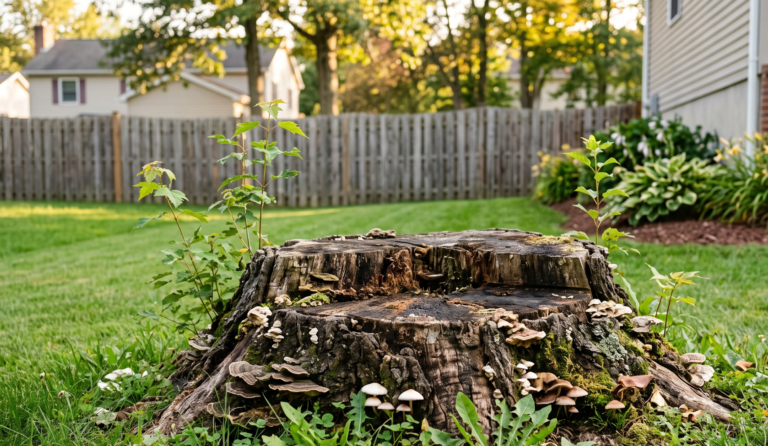
No. Fungi are natural decomposers breaking down residual subterranean roots. They do not harm perennial root systems and will fade once the buried wood finishes decomposing.
Correcting Common Soil Chemistry Problems
When an older, mature tree occupies a single piece of ground for decades, it changes the surrounding soil chemistry. Leaving its roots to decay underground continues that process. Addressing these variables ensures your replanting project thrives for years.
1. Soil Acidity and Pine/Oak Legacy
If the removed tree was an evergreen conifer (such as an Eastern white pine, spruce, or hemlock) or a massive pin oak, the soil below often leans acidic (pH 5.0 to 5.8).
- Turfgrass and most garden perennials perform best in a slightly acidic to neutral range (pH 6.2 to 6.8).
- Send a quick soil core sample to your local Cornell Cooperative Extension office (Monroe County office located on Highland Avenue in Rochester) or use an accurate digital pH probe.
- If testing indicates heavy acidity, broadcast pelletized calcitic or dolomitic agricultural limestone at the recommended rate (often 20 to 50 lbs per 1,000 sq ft) to raise the pH and unlock soil nutrients.
2. Overcoming Allelopathy (Black Walnut Toxicity)
If you had a black walnut (Juglans nigra) ground down, your soil would contain juglone, a naturally occurring biochemical substance that acts as an aggressive plant growth inhibitor.
- Juglone persists in residual root tissues for up to several years after tree felling.
- Sensitive plants—including tomatoes, peppers, azaleas, rhododendrons, hydrangeas, lilacs, and white pines—will wilt, display stunted growth, and die if planted in walnut-saturated zones.
- Solution: Either dig out the site comprehensively or plant exclusively juglone-tolerant species, such as Kentucky bluegrass, tall fescue, hostas, astilbes, coneflowers, daylilies, and Japanese maples.
Frequently Asked Questions
How do I find out if my soil is too acidic after removing an evergreen?
Take small soil core samples 4 inches deep from around the perimeter and center, mix them, and check them with a digital meter or drop a sample off at the Monroe County Cornell Cooperative Extension for testing.
How quickly does agricultural lime correct low soil pH?
Pelletized limestone takes roughly 2 to 6 months to break down and actively alter the soil pH profile, which is why amending during site preparation in early autumn pays dividends by spring.
How long does black walnut toxicity (juglone) stay active underground?
Juglone can remain present in root fragments for 1 to 3 years. If you cannot fully excavate the root bed, choose proven juglone-tolerant landscape plants and grasses.
Finding Reliable Stump Grinding Services Near You
When property owners search for dependable stump grinding near me, location, proximity, and equipment capability dictate the quality of the finished job. Having an experienced crew stationed nearby ensures fast service quotes, prompt arrival, and equipment chosen specifically for Monroe County residential layouts.
Greece Tree Service maintains active crews dispatched daily across every major community in Greater Rochester:
- Northwest Suburbs: Greece (Northgate, Paddy Hill, Barnard, Grandview Beach), Hilton, Hamlin, and neighborhoods along the Lake Ontario State Parkway.
- Central & East Metro: Rochester, Irondequoit (Seabreeze, Laurelton), Webster, Brighton, and Penfield.
- South & West Suburbs: Gates, Chili, Spencerport, Ogden, and Brockport.
Whether you need tight-access backyard stump grinding through a 36-inch garden gate off Dewey Avenue, heavy commercial clearing near Route 104, or complete root extraction before pouring a concrete patio, our local team provides the depth and precision needed to replant successfully.
Frequently Asked Questions
How quickly can a local stump grinding crew arrive at my property?
Because our crews are dispatched daily across Greece, Rochester, and neighboring suburbs, estimates are typically scheduled within 24 to 48 hours, with prompt emergency response available following major lake-effect wind events.
Can your stump grinders fit through standard residential backyard gates?
Yes. We operate commercial-grade narrow-access grinders specifically designed to pass through standard 36-inch walk gates without taking down fencing or damaging adjacent turf.
Are you insured and licensed for tree work near overhead utilities and property lines in Monroe County?
Greece Tree Service is fully insured with comprehensive liability and workers’ compensation coverage, operating in strict compliance with ANSI A300 tree care standards and Dig Safely New York (811) utility clearance protocols.
When to Call the Professionals: Why Proper Grinding Depth Matters
The success of your grass or garden replanting depends directly on the quality, thoroughness, and depth of the initial grinding work.
A cut-rate or rushed stump job often only grinds down 2 to 3 inches below the sod layer. This leaves a massive wooden core right under the surface. Once you shovel off the chips, your shovel rings against solid wood, leaving you unable to plant anything deeper than moss.
At Greece Tree Service, our ISA-certified team approaches every stump removal project with your ultimate landscape vision in mind.
- Deep-Grind Capability: Our high-powered, commercial-grade grinding equipment doesn’t just shave the top off; we grind well below standard depths, thoroughly chewing through the massive central core, primary taproots, and widespread lateral flare roots.
- Clean Slates with Full Excavation: When you plan to install hardscaping, plant a large replacement tree, or build an expansive raised patio, standard grinding might not be enough. We provide complete stump and root ball excavation, pulling the entire structural system out of the earth to give you a pristine, level canvas.
- Debris Management and Hauling: We respect your property. From protecting lawns with specialized protective matting to hauling away mounds of surplus grindings and backfilling the void, our team leaves your property neat, level, and ready for your landscaping plans.
Live Service Area & Map Verification
If you are planning to clear out dead, storm-damaged, or overgrown trees and want clean, healthy ground you can actually replant, partner with local arborists who know how to protect your landscape from start to finish.
Frequently Asked Questions
How deep does Greece Tree Service grind stumps compared to standard services?
Standard residential services often stop at 3 to 4 inches, leaving a wooden shelf. We grind deep—typically 8 to 12 inches or more—pulverizing major root flares so you have ample depth to establish healthy root systems.
Do you haul away all the leftover wood chips and debris?
Yes. We offer complete debris removal and site cleanup, hauling away the excess grindings and leaving the hole ready for clean topsoil and replanting.
When is total root ball excavation recommended over standard grinding?
Full excavation is ideal if you are pouring concrete footers, laying a paver patio, putting in a swimming pool, or planting a mature specimen tree in the exact same footprint.