When you cut down an aging oak or a hazardous ash on your property, it can be tempting to stop once the trunk hits the turf and simply leave the stump behind. But what happens if you leave a tree stump in your yard? Far from remaining an innocent, weathered wooden pedestal, an abandoned remnant triggers a slow-motion chain reaction: wood-decay fungi spread beneath your turf, wood-boring pests migrate closer to your foundation, invasive root suckers leach vital nutrients, and severe tripping hazards threaten your family and lawn equipment. In suburban neighborhoods throughout Greece, NY, and the greater Rochester region, untreated stumps also create drainage pockets and invite destructive winter freeze-thaw cycles that damage surrounding turfgrass. Understanding the biological and structural impact of an unaddressed tree base is the first step toward safeguarding your landscape, property value, and home safety.
1. Wood Decay and the Underground Fungal Highway
A tree does not instantaneously die when felled. The stump and its extensive underground root system retain stored moisture and starches, making them prime real estate for opportunistic saprophytic organisms.
Fungal Colonization and Armillaria Root Rot
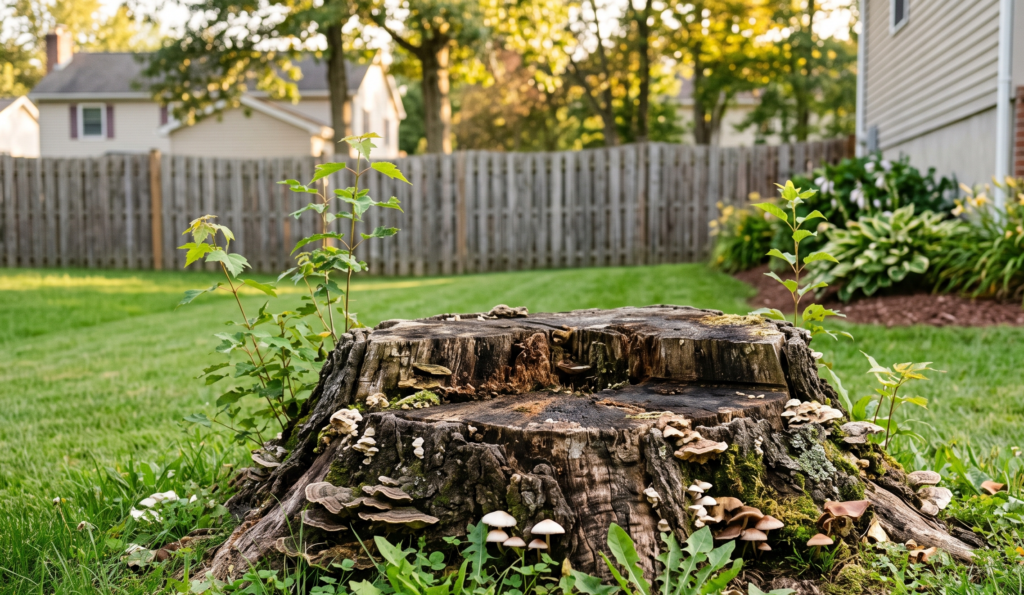
As soon as ambient humidity rises, airborne spores land on the exposed vascular cambium. Fungi like Armillaria mellea (honey fungus) colonize the decaying wood. While wood decay is natural on a forest floor, inside a managed residential yard it acts as an underground contagion:
- Mycelial Spread: White fungal mats and rhizomorphs (“bootlace strands”) run through the topsoil, traveling along old lateral roots.
- Cross-Infection: Nearby healthy trees, boundary hedges, ornamental maples, and lilacs can contract root rot via root-to-root contact, suffering canopy dieback and vascular collapse years later.
Toxic Mushrooms and Lawn Turf Danger
Decaying root structures regularly produce flushes of fungal fruiting bodies:
- Rings of mushrooms and bracket fungi push directly through your lawn grass, causing necrotic rings and unsightly discoloration.
- Many wild mushrooms sprouting from decaying hardwood are toxic to curious pets and toddlers who explore the backyard.
Frequently Asked Questions
Q: Can fungi from a rotting stump kill my other healthy yard trees?
A: Yes. Aggressive wood-decay fungi, especially honey fungus (Armillaria), travel underground through soil and intersecting root systems. If the infected roots of a decomposing stump touch the root flare of nearby trees, the pathogen can induce terminal root rot and canopy collapse.
Q: Why do wild mushrooms keep sprouting across my lawn even after I pick them?
A: The visible mushrooms are only the surface fruiting bodies of a deeper mycelial network feeding on decomposing underground roots. Until that buried wood substrate is ground out or decomposed, mushrooms will re-emerge during every wet weather cycle.
2. Pest Magnets: From Yard Inconvenience to Structural Threat
A rotting tree stump is the biological equivalent of an open buffet for insects that crave cellulose, damp wood, and subterranean shelter. Leaving it in your yard establishes a permanent satellite colony for destructive pests right outside your back door.
The transmission chain is simple and predictable: an abandoned stump or subterranean root base becomes an immediate nesting ground for subterranean termites that feed on tunneling wood, carpenter ants that excavate heartwood chambers, and rodents or wasps seeking underground shelter. As the rotting biomass becomes overcrowded or depletes, these pest colonies inevitably migrate toward the nearest wood structure—your home’s siding, deck joists, crawl space, and foundation sills.
Subterranean Termites
Subterranean termites (Reticulitermes flavipes) feed on the soft, deteriorating sapwood. Once a colony saturates the stump, winged swarmers emerge in late spring to establish new colonies—frequently targeting the nearest moisture-rich structural timber, such as your house sill plate, crawl space framing, or deck joists.
Carpenter Ants (Camponotus pennsylvanicus)
Unlike termites, carpenter ants do not digest wood; they excavate smooth tunnels inside damp, rotting heartwood to rear their brood. As the stump softens, the satellite nest expands. When outdoor foraging territory grows scarce, workers systematically forage through weep holes, window casings, and untreated exterior siding.
Wasps, Rodents, and Wildlife
Hollow cavities inside decomposing stumps offer dry shelters for yellowjacket ground nests, mice, voles, and raccoons. A stump tucked against a fence line or property boundary quickly evolves into a nest site that makes routine yard maintenance dangerous.
Frequently Asked Questions
Q: Will termites in an outdoor tree stump attack my house?
A: While not immediate, the probability is high. Subterranean termites build extensive underground foraging galleries spanning hundreds of feet. A decaying stump serves as a population multiplier until workers forage into nearby home foundations, sill plates, and deck framing.
Q: How can I tell if a stump has carpenter ants instead of termites?
A: Carpenter ants do not ingest wood; they chew smooth structural galleries and deposit coarse sawdust mounds mixed with insect parts (frass) around the base. Termites consume the cellulose, lining their interior tunnels with mud and leaving no sawdust.
3. Persistent Root Suckers and the Zombie Tree Problem
Many deciduous trees native to Monroe County—such as poplars, willows, locusts, and maples—possess aggressive dormant buds along their root flares.
Even without a primary trunk, active root systems pump remaining energy reserves into sending up dozens of rapid, vertical sapling sprouts known as root suckers or water sprouts.
- Robbing Soil Nutrients: These sprouts vigorously siphon nitrogen, phosphorus, and moisture from your topsoil, stunting adjacent flower beds and starving surrounding turf.
- Persistent Regrowth: Mowing over them merely prunes their tops, causing them to resprout thicker, woodier clusters that blunt lawnmower blades.
- Destructive Root Expansion: Until the root collar and stump are mechanically separated or ground below the grade, lateral roots continue pushing outward, lifting pavers, cracking asphalt driveways, and disrupting underground irrigation lines.
Frequently Asked Questions
Q: Can a tree grow back from an abandoned stump in Monroe County?
A: Yes. Deciduous varieties common to Upstate New York—such as green ash, boxelder, willow, and red maple—regularly push up adventitious water sprouts from the root collar, creating persistent, tangled brush clusters.
Q: Will mowing down tree sprouts eventually kill the stump?
A: Rarely. Mowing only prunes the tops of the sprouts, stimulating denser, woodier basal clusters that can bend lawnmower blades. The root system continues to draw nutrients until the stump core is mechanically ground out.
4. Lawn Safety, Equipment Damage, and Everyday Usability
Beyond biology, leaving a tree stump severely diminishes the functional usability of your outdoor living space.
| Problem Area | What Actually Happens | Real-World Cost / Hazard |
| Lawnmowers & Tractors | Blades strike hidden root flares or unyielding stump wood concealed by tall grass. | Bent crankshafts, chipped blades, broken spindles, or projectile wood chips costing hundreds in repairs. |
| Foot Traffic & Children | Low-cut stumps sit right below the knee line; hidden depressions form as soil collapses | Severe ankle sprains, falls, and potential personal liability claims from neighbors or delivery workers. |
| Aesthetics & Property Value | An unmaintained, blackened stump signals delayed exterior property maintenance. | Weakens curb appeal, slows home sales, and draws objections from local Homeowners Associations (HOAs). |
| Space Utilization | Surrounding ground remains unlevel, tangled, and unusable. | Prevents installation of patios, sheds, clean sod, gardens, or above-ground playground sets. |
Frequently Asked Questions
Q: Am I legally liable if someone trips over a tree stump in my yard in New York?
A: Under New York premises liability law, property owners must maintain reasonably safe exterior grounds. A hidden or low-cut stump concealed by turf can be treated as a foreseeable hazard in personal injury claims involving guests, delivery drivers, or service workers.
Q: Can hitting a tree stump really ruin my lawnmower engine?
A: Yes. Hitting unyielding hardwood at operating speeds often bends the engine crankshaft, shears the flywheel key, or cracks the mower deck, frequently resulting in equipment replacement costs that exceed the cost of professional stump grinding.
5. Sinkholes and Winter Freeze-Thaw in Upstate Climates
In northern and Great Lakes regions—such as Greece and Rochester along the shores of Lake Ontario—climate conditions amplify the hazards of buried wood.
- The Spongy Cavity: Over a span of 5 to 10 years, the underground core disintegrates. When deep taproots rot away, empty subterranean caverns develop beneath the topsoil layer.
- Sudden Sinkholes: Heavy spring rains wash topsoil into these cavities, causing localized ground subsidence. Lawnmowers and pedestrians can suddenly step through a thin crust of sod into a foot-deep drop.
- Frost Heave Exacerbation: Wet rotting wood absorbs water like a sponge. When winter sub-zero temperatures arrive, the saturated stump expands dramatically, lifting the surrounding sod and displacing adjacent concrete walkways, borders, and fence posts.
Frequently Asked Questions
Q: How does a decomposing stump cause sudden yard sinkholes?
A: As deep taproots and root crowns rot away beneath the surface, they leave structural voids. Saturated topsoil eventually settles into these caverns, causing the sod layer above to cave in under the weight of foot traffic or mowers.
Q: Can winter frost heaves around a stump displace my paved patio or driveway?
A: Yes. Spongy decaying wood absorbs water and expands substantially when freezing in Monroe County winters. This localized expansion pushes the surrounding ground upward, buckling adjacent pavers, walkways, and retaining walls.
6. Stump Grinding vs. Complete Stump Removal
When addressing a stubborn yard stump, property owners generally weigh two proven professional solutions: mechanical stump grinding or complete root-ball excavation.
When choosing your stump removal approach, the choice depends primarily on your future land-use goals:
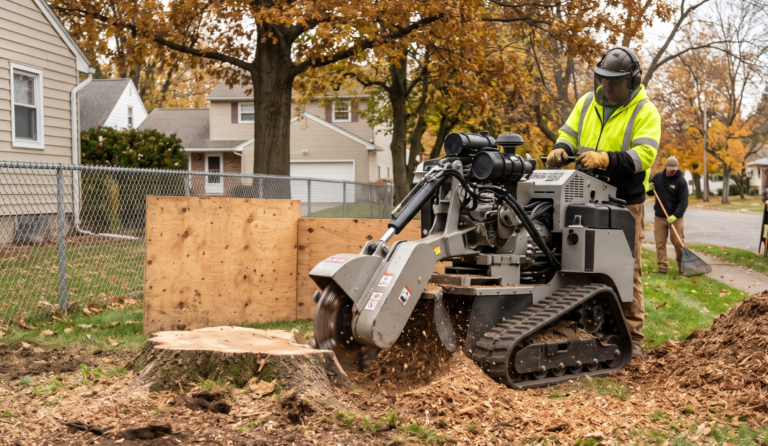
- Stump Grinding (Optimal for Lawns and Landscape Restoration): Uses specialized commercial machinery with rotating carbide teeth to pulverize the trunk core and visible surface flares 6 to 12 inches below soil level. The deeper lateral root network remains to rot harmlessly underground without tearing up your lawn. It causes minimal turf disruption, produces usable wood mulch, and allows you to fill, seed, or re-sod immediately at an affordable cost.
- Complete Stump Removal (Necessary for Construction and Excavation): Uses heavy hydraulic excavators or backhoes to forcibly yank the entire root ball and structural anchor network out of the earth. This process creates a massive subterranean crater and significant lawn disturbance, requiring soil hauling, regrading, and backfilling. It is strictly reserved for clearing foundation footprints, driveways, utility trenches, or inground pool installations.
Stump Grinding: Fast, Efficient, Low Impact
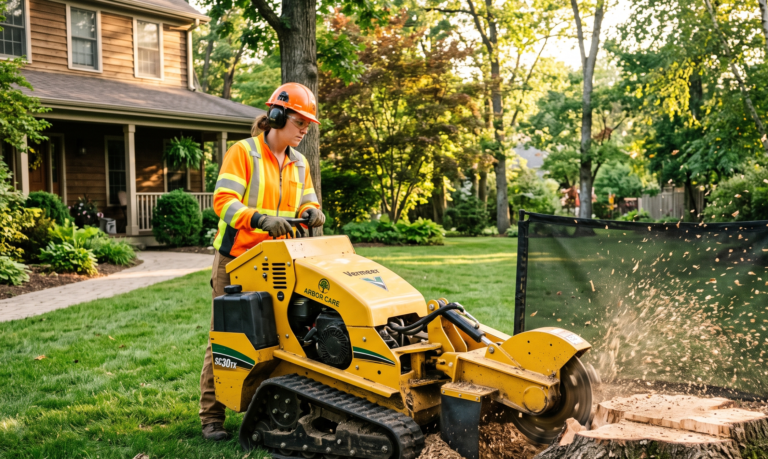
Our ISA-certified arborists at Greece Tree Service rely on industrial hydraulic stump grinders to chew the tree base and dominant root flare down 6 to 12 inches beneath ground level.
- Site Preserved: The surrounding turf remains intact without requiring heavy excavators driving across your lawn.
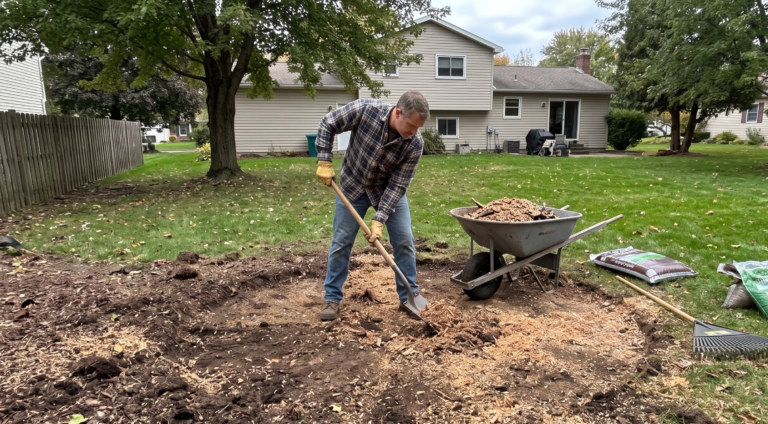
- Mulch Produced: The process produces organic wood chips that can be repurposed in landscape beds or raked away before leveling with screened loam and grass seed.
- Cost-Effective: Grinding requires less labor, lower machinery overhead, and minimal site backfilling compared to excavation.
Complete Stump Removal: Full Excavation
Complete removal involves using an excavator or winch rig to physically yank the root ball and primary anchor roots out of the earth.
- When It’s Needed: This process is reserved for new home foundations, building additions, deep in-ground swimming pool installations, or underground utility trenching.
- Considerations: Excavation leaves a wide crater that requires truckloads of structural fill, soil grading, and full lawn restoration.
Frequently Asked Questions
Q: How deep does professional stump grinding reach?
A: Commercial track grinders typically reduce the trunk collar and main surface root flares 6 to 12 inches below finished grade, creating ample clearance for fresh loam, grass seed, sod, or shallow flower beds.
Q: Can I plant a new tree directly in the spot where a stump was ground?
A: We advise planting 6 to 8 feet away. Freshly ground spots contain high concentrations of carbon-heavy wood chips that deplete soil nitrogen during breakdown, and leftover deep roots impede new root establishment.
7. The Risks of DIY Stump Removal Methods
It is common for homeowners to explore DIY removal hacks found on video forums. Unfortunately, home remedies frequently waste time, damage yards, or produce environmental hazards:
Epsom Salt and Chemical “Stump Out”
Commercial chemical stump rotters rely on potassium nitrate to accelerate decomposition.
- The Reality: The process still requires two to four years to soften a hardwood stump, leaving your yard vulnerable to pests and hazards the entire time.
- Toxicity: Chemical run-off can burn adjacent turfgrass and leach into nearby shallow domestic water tables.
Setting the Stump on Fire (“Stump Burning”)
Pouring kerosene or charcoal over an unyielding stump and allowing it to smolder is exceptionally dangerous. Underground root networks can smolder invisibly for days, traveling beneath fences, dry mulch beds, or home foundations before suddenly erupting into open flame.
Pulling Stumps with a Truck or Hitch Chain
Attempting to rip an anchored root system out using a pickup truck or utility tractor frequently results in snapped tow chains, shattered rear windshields, stripped transmissions, and severe physical injury. Hardwood root systems are engineered by nature to withstand gale-force winds—they will not yield safely to a standard vehicle.
Frequently Asked Questions
Q: Does pouring Epsom salt or motor oil speed up stump rot safely?
A: No. Epsom salt dehydrates wood slowly over several seasons without solving pest or tripping issues, while motor oil or fuel creates toxic ground contamination that violates environmental standards and kills surrounding grass.
Q: Why is burning a tree stump dangerous in suburban neighborhoods?
A: Underground root structures can smolder unseen for days beneath turf and mulch, following subterranean root channels under fence lines or wooden decks before reigniting on the surface.
8. Finding Reliable Stump Grinding & Tree Care “Near Me” in Monroe County
When searching for “stump grinding near me“ or “tree service near me“ along the southern shore of Lake Ontario, responsiveness, equipment clearance, and local environmental experience are paramount. Greece Tree Service is centrally stationed at 91 Mason Ave in Rochester, NY 14626, providing rapid deployment to residential and commercial properties throughout Monroe County.
Local Service Zones & Neighborhood Routes
Our crews regularly operate across key corridors in:
- Town of Greece: From Dewey Avenue and Long Pond Road up to Edgemere Drive, Grandview Beach, and Braddock Bay.
- Northwest Suburbs: Serving residential properties in Hilton (14468), Parma, and Hamlin along Route 259.
- West Rochester Metro: Dispatching crews across Gates (14624), Chili, and Charlotte near the Port of Rochester.
Precision Access & Municipal Safety Standards
Every local property poses unique challenges, from narrow backyard access to shallow utility lines. We eliminate the friction of yard remediation by providing:
- Turf-Friendly 36-Inch Access: Our track grinders fit cleanly through standard suburban garden gates, eliminating fence removal or heavy tire ruts across your yard.
- Mandatory 811 Dig Safely Coordination: We handle utility clearance verification prior to grinding below grade, protecting buried gas lines, fiber optics, and municipal water lateral pipes.
- Turnkey Site Leveling: We don’t leave unsightly chip piles behind unless requested for landscape mulch. Our crew can haul away excess grindings, backfill the depression with premium loam, and lay certified seed matched to Upstate New York turf conditions.
Direct GBP Map Pin & Office Location
Frequently Asked Questions
Q: Can your stump grinding machines fit through standard 36-inch yard gates?
A: Yes. Our commercial equipment fleet includes compact, turf-friendly track grinders engineered specifically to clear standard 36-inch residential garden gates without gouging established lawns.
Q: Do you coordinate with Dig Safely New York (811) before grinding?
A: Always. We verify that all buried utilities—including natural gas lines, power conduits, and municipal communications—are clearly located and marked before mechanical teeth break ground.
9. Contact Greece Tree Service Today
Eliminating an abandoned stump protects your foundation from subterranean pests, prevents cross-contamination of root fungi, and reclaims your yard’s functional living space.
Connect directly with our local arboricultural specialists for an on-site property evaluation:
- Physical Office: 91 Mason Ave, Rochester, NY 14626
- Direct Line: (585) 628-8744
- Schedule Online: Request an Estimate at Greece Tree Service
- Service Hours: Monday – Saturday: 7:00 AM – 6:00 PM | 24/7 Emergency Tree Response