If you have recently had a hazardous tree taken down or lost an aging oak during a Western New York windstorm, you are likely staring at an unsightly wooden obstacle in the middle of your lawn. Deciding between stump grinding vs. stump removal is the vital next step in reclaiming your outdoor living space. While both methods eliminate above-ground tripping hazards and restore the visual appeal of your yard, they represent two fundamentally different approaches to subsurface root management, equipment footprint, labor intensity, and long-term landscaping goals. Understanding the distinct mechanical processes, financial investments, and ecological impacts of professional stump grinding and complete stump removal ensures you pick the perfect solution tailored to your lawn’s specific needs.
At Greece Tree Service, our ISA-certified arborists and heavy machinery specialists tackle tree and root obstacles daily throughout Greece, Rochester, and Monroe County. Whether you are planning to lay fresh turf, pour a new concrete patio, or safeguard your foundation from invasive pests, this guide breaks down every technical nuance between grinding and extraction so you can make an informed, confident investment.
1. What Is Stump Grinding? Mechanics, Depth, and Root Biology
Stump grinding is the most widely utilized, efficient, and turf-friendly method used by professional tree care contractors to eliminate leftover tree stumps. Rather than unearthing the entire biological root base of the tree, grinding focuses on mechanically pulverizing the wood down into the soil level.
The Grinding Mechanism and Depth
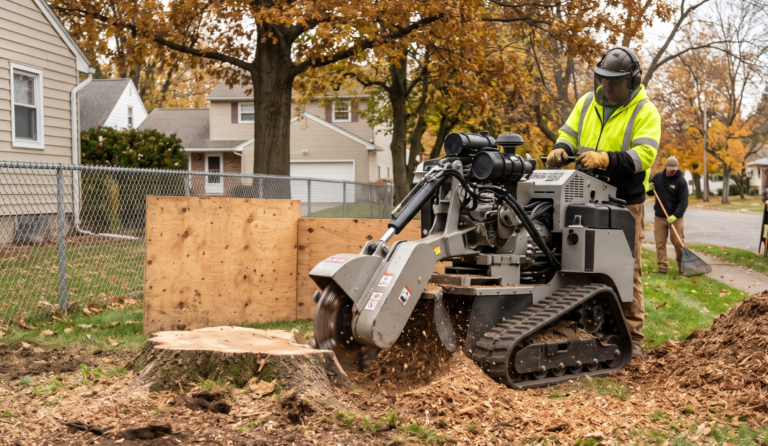
A commercial stump grinder utilizes a high-torque rotating steel cutting wheel fitted with heavy-duty tungsten carbide teeth. Operating under controlled hydraulic articulation, the machine operator sweeps the spinning cutting wheel back and forth across the wood collar, shaving the trunk down layer by layer.
Professional crews typically grind the stump down anywhere from 4 to 12 inches below the surface grade, tailored to what you plan to do with the space next:
- 4 to 6 inches below grade: The standard depth for residential properties where the homeowner intends to backfill the cavity with screened topsoil, broadcast perennial turf seed, or install sod.
- 8 to 12+ inches below grade: Recommended when the property owner plans to install a shallow perennial garden, plant non-woody ornamental shrubs, or lay sand-set interlocking patio pavers.
What Happens to the Underground Roots?
During stump grinding, only the stump itself and the prominent surface root flares immediately adjacent to the trunk base are pulverized. The vast underground network of lateral structural roots and deeper vertical sinker roots remains buried in the soil profile.
Because the tree has been severed from its photosynthetic crown, the root system dies. Over the course of 5 to 10 years, these subterranean roots naturally desiccate, break down, and decompose. As microscopic fungi and beneficial soil bacteria break down the wood fibers, the decomposing roots enrich the surrounding soil with organic matter without causing catastrophic ground sinkage.
The Byproduct: High-Quality Wood Mulch
Grinding transforms a dense, obstructive wood trunk into a generous volume of blended wood chips and native soil. This material can be repurposed immediately as organic garden mulch to retain soil moisture around perimeter plantings or hauled away by your tree care crew so the cavity can be backfilled immediately with clean screened topsoil.
Frequently Asked Questions
How deep does commercial stump grinding go?
Most standard residential grinding projects reach between 4 and 8 inches beneath the surface grade, which is ideal for turf establishment. For specialized replanting or landscaping projects, high-horsepower commercial grinders can plunge 12 to 18 inches below grade.
Will the remaining underground roots rot away naturally?
Yes. Deprived of the trunk and foliage, the underground root system can no longer produce starches through photosynthesis. Over several years, indigenous soil microbes, fungi, and beneficial bacteria slowly decompose the root wood, turning it into rich organic humus.
Can a stump grinder fit through standard backyard gates?
Yes. Professional tree care outfits utilize compact, self-propelled stump grinders equipped with turf-friendly rubber tracks or dual tires that easily navigate standard 36-inch walk-through gates without damaging residential turf.
2. What Is Stump Removal? Complete Mechanical Excavation
Stump removal—often called mechanical root extraction or grubbing—is a much more aggressive, comprehensive civil and horticultural operation. It is chosen when the underground space must be completely cleared of all organic wood matter to prepare for civil engineering or deep structural development.
The Excavation Process
Complete stump removal does not merely shave down the visible wood; it rips the entire biological root core of the tree out of the earth.
To execute complete removal:
- Underground Utility Clearance: Technicians verify utility marks via Dig Safely New York (811) to avoid severing gas lines, electrical conduits, water mains, or fiber-optic cables.
- Trenching and Root Severing: Heavy machinery—such as an 8-ton mini-excavator, track loader, or backhoe—digs a deep perimeter trench around the outer drip zone of the stump flare. Heavy-duty hydraulic shears, reciprocating root saws, and axes sever the thick lateral anchor roots.
- Hydraulic Prying and Hoisting: The machinery uses tremendous leverage to pry the central root ball and taproot free from the hard subsoil clay.
- Debris Hauling and Backfilling: The massive, soil-caked root ball (which can weigh anywhere from 1,000 to over 5,000 pounds) is lifted into a dump trailer and hauled off-site. The resulting crater must then be filled with multiple cubic yards of structural fill dirt, compacted in mechanical lifts, and top-dressed.
Frequently Asked Questions
Why is complete removal so much more disruptive than grinding?
Removal extracts the full root ball, which often extends 3 to 5 feet into the ground and spans several feet across. This requires heavy earth-moving equipment that creates a wide excavation trench, displaces significant soil, and leaves a substantial hole that must be refilled.
When is complete removal strictly required?
Complete excavation is mandatory if you plan to build structural foundations, pour footings for a home addition, pave a driveway, install an in-ground swimming pool, or trench for municipal utilities where decomposing roots could cause voids or foundation shifts.
What happens to the extracted root ball?
Because the root ball is heavily entangled with rocks, dense clay, and dirt, it cannot be run through a standard wood chipper. It must be winched onto a heavy trailer and hauled to an organic recycling depot or commercial disposal facility.
3. Direct Head-to-Head Comparison: Grinding vs. Removal
To evaluate which service matches your exact landscape and budget requirements, consider how the two approaches compare across core operational factors:
| Decision Factor | Stump Grinding | Complete Stump Removal |
| Primary Objective | Eliminates visible stump; flattens lawn surface | Completely extracts stump, root ball, and taproot |
| Machinery Used | Compact, turf-friendly stump grinder | Heavy excavators, backhoes, tow winches, root saws |
| Impact on Yard | Low; localized chipping zone with minimal soil disturbance | High; substantial excavation trench, soil displacement, heavy equipment tracks |
| Labor & Time | 45 minutes to 2 hours per standard stump | Half a day to a full day involving multiple heavy machines |
| Average Cost | Budget-friendly ($150 – $450 depending on size) | Substantially higher ($500 – $1,800+ with hauling) |
| Site Cleanup | Wood chips left for mulch or raked away | Massive root ball must be hauled and disposed of at landfill. |
| Subsurface Roots | Left in place to decompose naturally over years | Physically severed and excavated from the ground |
| Replanting Trees | Cannot plant a large tree in the exact same spot | Can plant a new tree in the exact same footprint |
| Structural Prep | Unsuitable for load-bearing footings/pools | Mandatory for building foundations, additions, or pools |
Frequently Asked Questions
Which option is more cost-effective for a typical homeowner?
Stump grinding is significantly more economical. Because it requires less machinery, fewer crew hours, and minimal site remediation, grinding typically costs a fraction of complete mechanical extraction.
Can I plant a new tree in the exact same spot after grinding?
It is not recommended to plant directly in the center of a ground stump cavity, as decomposing core roots temporarily tie up nitrogen and block root development. If you grind, plant your new tree 5 to 8 feet away. If you must use the exact spot, opt for full removal.
Which process takes less time to complete on-site?
Stump grinding takes roughly 30 to 90 minutes for a standard hardwood stump. Complete excavation often requires several hours to an entire day due to trenching, root severance, extraction, and haul-away logistics.
4. In-Depth Decision Factors: Making the Right Choice for Your Property
Choosing between stump grinding and complete stump removal requires evaluating your property’s future plans, soil health, proximity to structures, and budget.
Future Landscaping and Construction Goals
Your vision for the area dictates the correct service:
- Sod, Lawn Turf, or Flower Beds: Choose Stump Grinding. If your goal is to reclaim an unobstructed lawn for mowing, children playing, or installing flower beds, grinding 6 to 8 inches down provides ample room for healthy topsoil and turf grass root systems.
- Poured Concrete, Driveways, or House Additions: Choose Stump Removal. When constructing a structural addition, detached garage, paved driveway, or in-ground swimming pool, leaving roots behind is prohibited by building codes. As remaining roots decompose underground, voids and air pockets form, causing localized soil settling, foundation cracking, or patio subsidence.
- Replanting a New Canopy Tree in the Identical Location: Choose Stump Removal. If you want to plant another substantial shade tree (such as an oak, sugar maple, or disease-resistant elm) in the exact same hole, complete excavation is needed to clear space for the new sapling’s root network. Alternatively, you can opt for stump grinding and simply offset your new planting 5 to 8 feet away in fresh, uncompacted soil.
Lawn Disruption and Property Impact
Modern landscape equipment varies wildly in how it treats your turf:
- Stump Grinders: Contemporary professional stump grinders feature articulating tracks or low-pressure turf tires designed to distribute machine weight evenly. They can squeeze through standard backyard pedestrian gates without tearing up surrounding sod, flower garden borders, or adjacent flagstone walkways.
- Excavation Machinery: Excavators and backhoes require wide clearance, overhead branch clearance, and broad turning radii. Heavy tracks can compress soil, leave ruts in soft spring lawns, and disrupt nearby irrigation lines or landscape lighting. Restoring your yard following full removal requires grading, fill dirt, compaction, and reseeding.
Pest Prevention and Biological Decay
Homeowners often ask, “If I leave the underground roots after grinding, will I invite termites or carpenter ants?”
When a tree stump is ground 6 to 12 inches below the surface, severed from sunlight, and buried under packed topsoil, the conditions that wood-boring insects seek are greatly diminished. Subterranean decay is driven by beneficial microscopic fungi and actinobacteria that slowly digest cellulose and lignin into fertile humus.
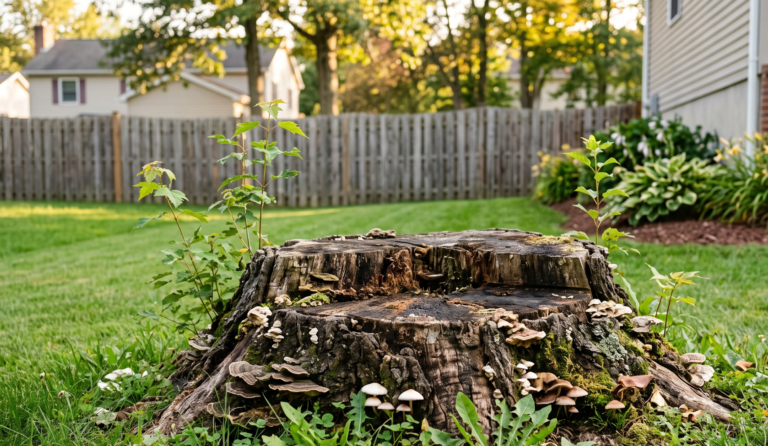
However, if an above-ground stump is left untouched, it becomes a moist, elevated sponge—an ideal incubator for:
- Subterranean Termites: Pests that thrive in damp deadwood and can migrate toward residential sills and framing.
- Carpenter Ants: Insects that hollow out rotting wood to build nesting galleries.
- Wood-Rotting Fungi (Armillaria / Honey Fungus): Pathogens that can infect nearby ornamental trees or spread through interconnected root systems.
Both grinding and removal resolve this problem by eliminating the moist, exposed stump core that acts as a nesting beacon.
Frequently Asked Questions
Will leaving root systems underground attract carpenter ants or termites?
Once a stump is ground down and buried beneath soil and turf, subterranean decomposition is dominated by soil micro-organisms rather than nesting insect colonies. The main pest attractor is the above-ground, moist wooden stump exposed to open air.
Can stump grinding machinery damage my underground sprinkler lines?
If shallow sprinkler lines run immediately over or through the root flare, they can be damaged by grinding teeth. Marking private lines prior to the service allows the arborist to adjust the machine’s sweep and hand-expose delicate lines.
How does soil settling differ between grinding and removal?
With stump grinding, settling is minimal because the subsoil architecture remains intact. With complete removal, the large excavation cavity must be compacted in stages with fill soil; otherwise, natural rain and gravity will cause ground slumping over time.
5. Hidden Liabilities: Why You Shouldn’t Leave a Stump Untouched
Some property owners consider skipping stump remediation entirely to save money. While leaving a stump behind may seem harmless initially, it introduces several hidden liabilities:
- Constant Tripping Hazard and Liability: Low-cut stumps hidden by tall grass, autumn leaves, or winter snowdrifts present a serious safety hazard for children playing, guests walking your grounds, and pets running through the yard. In suburban neighborhoods, an unmarked stump near property borders can even create municipal code or homeowner insurance liability issues.
- Mower and Blade Destruction: Mowing around an old stump turns routine lawn maintenance into a hassle. Striking hidden root flares or a hardened stump base dulls or snaps expensive mower blades, bends crankshafts, and damages lawn tractor decks.
- Persistent Sucker Growth and Resprouting: Deciduous trees common to upstate New York—including willows, silver maples, poplars, and tree of heaven—do not die simply because their trunk has been felled. The lingering root system continues pumping sap, resulting in dozens of aggressive, wild sapling shoots (suckers) springing up around the perimeter. These shoots siphon nutrients and moisture from your surrounding lawn and garden, requiring constant trimming to keep at bay.
- Diminished Property Aesthetics and Curb Appeal: A decaying, moss-covered stump disrupts the clean, open look of your property. Real estate professionals consistently note that well-maintained landscapes add substantial value to a home’s curb appeal, whereas visible yard debris and hazardous tree remnants can raise red flags for prospective buyers.
Frequently Asked Questions
Can an old stump cause tree diseases to spread to healthy trees?
Yes. Decaying stumps often host fungal pathogens such as honey fungus (Armillaria), which can produce fungal mats that spread underground to infect the roots of adjacent, healthy ornamental and shade trees.
Why does a stump keep sprouting new branches after the tree is cut down?
The living root system still retains stored energy reserves and hormones that trigger epicormic buds to sprout shoots (suckers) in an attempt to regrow foliage and resume photosynthesis.
Will chemical stump rotters remove a stump faster than mechanical methods?
Chemical rotting agents (potassium nitrate) accelerate decomposition, but the process still takes two to four years. Mechanical grinding eliminates the stump in less than an hour, providing an instant solution.
6. Managing Wood Chips and Soil After Stump Grinding
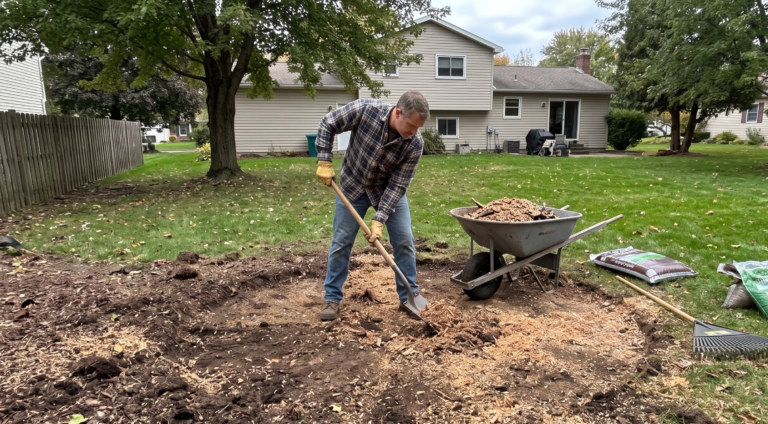
A common surprise for homeowners following a stump grinding project is the sheer volume of wood mulch produced. Because intact wood expands into aerated chips when shredded, a single 24-inch stump can yield several wheelbarrows of mulch.
Here is how you can put those wood chips to work:
- Perimeter Garden Mulch: Let the chips age for a few weeks to begin initial decomposition, then spread them in a 2- to 3-inch layer across flower beds, around shrubs, and along fence lines to suppress weed growth and retain soil moisture.
- Compost Enrichment: Blend the carbon-rich (“brown”) wood chips with nitrogen-rich grass clippings (“greens”) in your backyard compost bin to produce organic soil amendment.
- Backfilling the Grinding Hole: Mix a balanced ratio of the fine wood shavings with clean topsoil to backfill the cavity. Over the next year, the organic material settles naturally, creating a level foundation for seeding lawn grasses.
- Full Haul-Away Service: If you prefer a completely clean yard with zero raking or cleanup on your part, request full debris removal from your tree service team.
Frequently Asked Questions
Do freshly ground wood chips deplete nitrogen from my lawn soil?
As fresh wood chips decompose on the soil surface, microbes temporarily consume available surface nitrogen. Adding a slow-release, nitrogen-rich starter fertilizer when reseeding grass ensures lush growth.
Can I put freshly ground mulch directly into my vegetable garden?
Fresh mulch is best used for landscape pathways or around established woody shrubs. For sensitive annual vegetable gardens, let the wood chips compost for 3 to 6 months until they break down into darker, stabilized organic matter.
How long after grinding can I sow grass seed?
You can sow grass seed the same day. Simply shovel out the excess wood chips until the cavity is mostly clean, fill the hole with rich topsoil, tamp lightly, distribute quality seed, and keep the area consistently moist.
7. Local Soil & Environmental Factors in Greece & Monroe County, NY
Tree root growth and decomposition dynamics in Greece, NY, are heavily influenced by our distinctive Western New York climate and native soil geography:
- Dense Glaciated Clay Soils: Much of Greece, Henrietta, and the surrounding towns feature Ontario silt loam and dense lacustrine clay soils. Because these heavy clay soils have limited natural drainage, complete stump excavation can leave large craters that collect water like a retention basin during wet spring thaws. Backfilling an excavation hole in clay requires structured compaction to prevent uneven pooling. Stump grinding keeps the subsoil structure intact while allowing local micro-organisms to break down the roots over time.
- Emerald Ash Borer (EAB) Aftermath: Across Monroe County, thousands of green and white ash trees have succumbed to Emerald Ash Borer damage in recent seasons. Once an ash tree dies, its root system becomes brittle quickly. Property owners clearing standing dead ash require prompt stump remediation to prevent fungus proliferation and opportunistic carpenter ant infestation.
- Lake Ontario High Wind Exposure: Properties situated along North Greece, Edgemere Drive, and the Lake Ontario shoreline experience continuous wind exposure and seasonal lake-effect storms. When trees along the lakeshore are removed due to windthrow risk, choosing stump grinding allows homeowners to level their coastal yard while stabilizing the surrounding shoreline subsoil with the remaining decomposed root fibers.
Frequently Asked Questions
Does the high water table near Lake Ontario affect stump grinding?
In shoreline neighborhoods with a high water table, grinding is strongly preferred over deep excavation. Trenching out a deep root ball in soggy clay can trigger mud holes and pooling water, whereas surface grinding leaves the underlying soil structure intact.
When is the best season in Western New York to grind a tree stump?
Stump grinding can be performed year-round as long as the ground is not deeply frozen under heavy snowpack. Spring, summer, and autumn are optimal for backfilling and establishing fresh grass seed before winter sets in.
Do town ordinances in Greece, NY, require calling 811 before stump work?
Yes. New York state law requires contacting Dig Safely New York (811) at least two business days prior to any mechanized underground excavation, including deep stump grinding and backhoe extraction, to protect public utility lines.
8. Preparing Your Yard for Professional Service
To ensure a seamless, safe, and efficient stump grinding or removal project, follow these preparatory steps before the crew arrives on site:
- Clear Surface Rocks and Debris: Remove any landscape stones, decorative bricks, solar lights, toys, or dog tethers within a 10-foot radius of the stump. Striking hard rocks or metal can damage grinder teeth and create flying projectile hazards.
- Flag Hidden Subsurface Fixtures: Mark private underground lines such as underground dog fences, sprinkler system lines, landscape drip tubing, or low-voltage garden lighting wires.
- Provide Equipment Access: Ensure gates are unlocked, vehicles are moved out of the driveway, and clear pathway access (at least 36 to 48 inches wide) is available to the backyard.
- Coordinate Underground Utility Stakes: Professional companies notify Dig Safely New York (811) prior to any deep excavation or intensive below-grade grinding to identify public gas, electric, and communication lines.
- Secure Pets and Family Members: Keep dogs and children safely indoors while machinery is operating to maintain a safe perimeter.
Frequently Asked Questions
How wide must my side gate be for stump grinding access?
Most standard commercial stump grinders require an opening of at least 36 inches. If you have an extra-narrow gate, notify your contractor in advance so they can dispatch a narrow-chassis machine.
Do I need to be home while the stump is being ground?
As long as the crew has clear gate access, private utilities are clearly marked, pets are indoors, and payment arrangements are in place, you do not need to be on the property during the service.
What safety measures are taken to protect surrounding windows and cars?
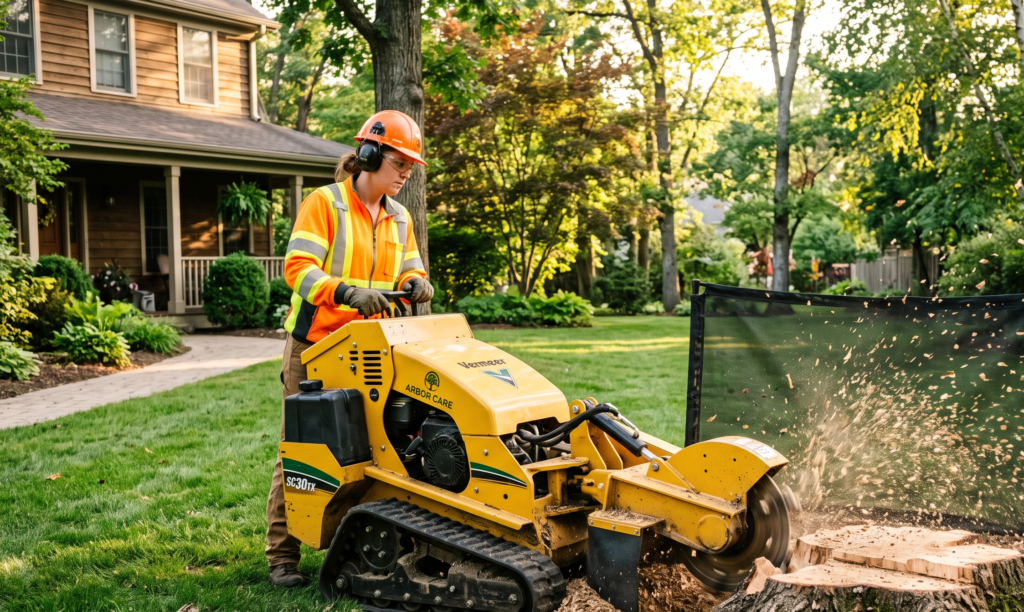
Professional crews place heavy-duty safety curtains or ballistic mesh deflector screens around the perimeter of the stump to contain flying chips, soil clods, and pebbles during high-speed cutting.
9. Tree Stump Grinding & Removal Service Areas Near You in Monroe County
When property owners search for dependable tree care and stump remediation “near me,” geographic proximity, rapid dispatch times, and hands-on familiarity with local Western New York soil conditions make all the difference. Located centrally at 91 Mason Ave in Rochester, Greece Tree Service operates daily throughout the northwest suburbs, lakeshore towns, and greater Monroe County communities.
Whether your home sits near the waterfront off Edgemere Drive, along the bustling commercial corridors of West Ridge Road, or in a historic residential neighborhood in Hilton or Spencerport, our tree care specialists are equipped with the precision machinery needed to handle any job.
Communities & Neighborhoods We Frequently Service:
- Town of Greece: North Greece, Grand View Heights, Braddock Bay, Edgemere Drive lakefront, and the Dewey–Stone residential corridors.
- Rochester Metro & Neighboring Suburbs: Gates, Chili, Irondequoit, Hilton, Spencerport, Parma, and Charlotte.
- Monroe County Zip Codes Covered: 14626, 14612, 14616, 14615, 14606, 14468, and 14559.
Find Our Local Dispatch Center
We maintain fully licensed and insured commercial-grade stump grinders, crane trucks, and wood-processing haulers right here in the community. You can find our headquarters, view recent client reviews, and get driving directions using our verified Google Maps profile below:
Frequently Asked Questions
How quickly can Greece Tree Service inspect a stump on my property?
Because our dispatch yard is located on Mason Ave in Rochester, we can typically schedule on-site inspections and provide detailed written estimates within 24 to 48 hours for properties in Greece and neighboring Monroe County towns.
Are your stump grinding and removal crews fully insured in New York?
Yes. Greece Tree Service carries comprehensive general liability insurance, commercial vehicle protection, and full New York State Workers’ Compensation coverage to protect you and your property.
Do you handle both tree removal and stump grinding in a single appointment?
Yes. We can seamlessly bundle full tree felling, hazard mitigation, brush chipping, and below-grade stump grinding into a single visit to save you time and maximize project savings.
10. Reclaim Your Lawn with Greece Tree Service
A lingering tree stump should not compromise the beauty, safety, or usability of your outdoor living space. For the majority of residential yards throughout Greece and Monroe County, stump grinding provides the optimal balance of speed, turf preservation, and cost-effectiveness. If your future plans involve building foundations, swimming pools, or utility trenching, complete stump removal remains the definitive solution.
At Greece Tree Service, our ISA-certified team brings decades of combined experience, state-of-the-art turf equipment, and dedicated customer service to every job. Let us take care of the heavy lifting so you can enjoy a flat, vibrant, and hazard-free yard.
- Business Name: Greece Tree Service
- Address: 91 Mason Ave, Rochester, NY 14626
- Phone: (585) 628-8744
- Website: greecetreeservice.com
- Get Started: Request Your Free Estimate Today