Living along the southern shore of Lake Ontario means experiencing some of the most dynamic, breathtaking seasons in Upstate New York. But when late autumn transitions into winter across Monroe County, that beauty brings severe weather. Powerful squall lines, lake-effect snow bands, and ferocious gale-force winds barrel unimpeded across the open water, slamming directly into neighborhoods from Charlotte and North Greece down through Irondequoit and the city of Rochester. If you want to protect your home, roof, vehicles, and utility lines from catastrophic failure, preparing your property’s trees for Lake Ontario and Rochester winter windstorms is a critical homeownership priority. Investing in proactive tree service in Greece, NY, professional tree trimming, and expert winter tree care in Rochester before the ground freezes solid ensures your landscape can withstand the relentless winter elements.
At Greece Tree Service, our local ISA-certified arborists spend year after year helping property owners throughout Greece (14612, 14616, 14626) and greater Rochester prevent hazardous tree damage. Trees are immense physical assets, but when exposed to the violent combination of saturated lakefront soil, freezing rain, and sustained 50 to 70 mph wind gusts, even a seemingly healthy shade tree can develop structural compromises.
In this comprehensive, arborist-backed guide, we dive into the specific atmospheric physics of Lake Ontario windstorms, explain why local tree species fail, detail proactive pruning strategies, outline municipal considerations, and provide you with an actionable maintenance checklist to safeguard your property all season long.
1. The Anatomy of Lake Ontario & Rochester Winter Windstorms
To understand how to protect your trees, you first need to understand the distinct meteorological forces at play in our corner of Western New York.
Rochester and the Town of Greece sit directly on the leeward edge of Lake Ontario. Unlike communities further inland that benefit from natural topographic windbreaks, our coastal and near-coastal areas take the direct, unbuffered brunt of weather systems moving southeast out of Canada or northeast through the Great Lakes basin.
The Lake Fetch Effect and Wind Amplification
When cold polar air streams across hundreds of miles of open, relatively warm lake water, it meets virtually zero surface friction. This extended “fetch” allows low-pressure storm systems to accelerate significantly. By the time these gusts hit coastal communities—such as Edgemere Drive, Grandview Beach, Braddock Bay, and neighborhoods along the Lake Ontario State Parkway—they arrive with violent turbulence. Trees on these properties act as massive wind sails, absorbing tons of lateral dynamic force with every gust.
Saturated Subsoils and Thaw-Freeze Cycles
Winter windstorms in Monroe County rarely arrive in dry conditions. Early winter storms frequently pair gale-force winds with heavy rains or rapidly melting lake-effect snow. The glaciolacustrine soils common throughout Greece and the Genesee River basin—rich in dense clays and silty loams—drain slowly. When the root zone becomes supersaturated, soil cohesion drops dramatically. When a 60 mph gust strikes a tree rooted in mud, the soil provides insufficient anchor resistance, leading to full-scale windthrow (where the entire root plate tears clean out of the earth).
The Compounding Weight of Ice and Dense Snow
Lake-effect precipitation is notoriously heavy and wet. When freezing rain deposits a glaze of ice measuring just a quarter-inch to a half-inch thick, it adds hundreds to thousands of pounds of static load to a mature tree’s canopy. When high winds hit ice-encrusted branches that have lost their natural flexibility due to sub-freezing temperatures, the mechanical stress exceeds the wood’s tensile threshold, causing violent branch snapping and trunk fractures.
Frequently Asked Questions
Q: Why are windstorms in Greece and Rochester more damaging to trees than inland storms?
A: Wind systems traveling over Lake Ontario encounter almost no land friction, allowing wind speeds to accelerate across the open water (the “fetch effect”). When these high-velocity gusts make landfall, they hit coastal trees with intense, unbuffered lateral forces while local soils are often already saturated by lake-effect precipitation.
Q: What is tree “windthrow,” and why does it happen here?
A: Windthrow occurs when a tree’s entire root ball lifts and pivots out of the ground instead of the trunk snapping. In Greece and Rochester, dense clay-heavy subsoils easily become waterlogged from melting snow and lake squalls, reducing soil friction and allowing heavy gusts to uproot mature trees completely.
Q: Does ice accumulation make wind gusts more dangerous to trees?
A: Yes. Even a thin layer of glaze ice adds thousands of pounds of static weight to an average canopy. In sub-freezing conditions, cold wood becomes more brittle, making ice-laden branches far more vulnerable to fracturing under sudden wind shear.
2. High-Risk Tree Species Commonly Found in Greece & Rochester
Not all trees react to winter wind events in the same way. The age of a neighborhood and the types of trees planted decades ago during suburban expansion play massive roles in determining property risk. In Greece, NY, where suburban tracts developed rapidly from the 1950s through the 1990s, certain species dominate residential landscapes.
Silver Maple (Acer saccharinum)
Silver maples are ubiquitous across older Greece neighborhoods, particularly along corridors like Maiden Lane, Long Pond Road, and Britton Road. While loved for their rapid growth and expansive shade, they possess brittle, weak wood and notoriously poor branch architecture. They frequently produce multiple co-dominant leaders with narrow, “V-shaped” crotches that trap bark. Under high wind and heavy snow loads, these weak unions split vertically down the trunk, often dropping massive limbs onto houses, driveways, or power cables.
Norway Maple (Acer platanoides)
Widely planted as street trees throughout Rochester in the mid-to-late 20th century, Norway maples develop exceptionally dense, umbrella-like canopies. Because their crowns catch wind like a solid sail rather than letting air filter through, lateral forces place enormous shear stress on their shallow, surface-level root systems. They are also prone to internal trunk decay and girdling roots that remain hidden until severe weather strikes.
Green and White Ash (Fraxinus pennsylvanica / Fraxinus americana)
Throughout Monroe County, the Emerald Ash Borer (EAB) has devastated native ash populations. If your property contains standing ash trees that have died or are heavily infested, they represent an immediate life-safety hazard. Dead ash wood loses its moisture content rapidly, becoming extremely brittle within months. Unlike some hardwoods that gradually shed small twigs before failing, dry ash trees frequently snap off at mid-trunk or shatter unpredictably without warning during even moderate wind events.
Eastern White Pine (Pinus strobus)
White pines add rich evergreen color to Rochester properties, but their sweeping, brittle limbs and persistent needles retain massive amounts of wet, lake-effect snow. Combined with their high center of gravity, winter storms often cause catastrophic limb tearing or whole-tree snapping, particularly on properties exposed to unrestricted lakefront gusts.
Frequently Asked Questions
Q: Why are silver maples so prone to splitting during winter storms?
A: Silver maples grow rapidly, producing soft, brittle wood fiber. They frequently develop co-dominant trunks with tight “V” crotches containing embedded bark, which creates a natural mechanical fault line that easily cleaves open under storm loading.
Q: Can a dead ash tree be left standing through the winter if it hasn’t fallen yet?
A: No. Ash trees killed by the Emerald Ash Borer rot internally and lose structural integrity very quickly. They are notoriously brittle (“snap trees”) and can drop large scaffold limbs or collapse completely under moderate winter winds.
Q: How do evergreen pines react differently to windstorms compared to deciduous hardwoods?
A: Deciduous trees shed their leaves in autumn, which naturally reduces wind drag and prevents snow accumulation. Conifers like Eastern White Pines keep their needles all year, creating an enormous surface area that catches heavy wet snow and acts as an aerodynamic sail during high winds.
3. Warning Signs: How to Identify Hazardous Trees Before Winter
Detecting structural vulnerabilities before the first major lake storm rolls across the water can save thousands of dollars in emergency structural repairs. Inspect your trees from the ground up using these arborist criteria:
| Structural Defect | What to Look For | Potential Failure Mode in High Wind | Recommended Action |
| Co-Dominant Stems | Two or more main trunks of similar diameter forming a sharp “V” shape rather than a wide “U” | Trunk splitting down the middle under dynamic swaying forces | Crown reduction, structural pruning, or supplemental tree cabling |
| Included Bark | Bark pinched inward between tightly pressed upright stems | Mechanical weakness at union; total stem tearing | Corrective weight-reduction pruning; cabling/bracing |
| Deadwood & “Hangers” | Leafless, barkless branches or limbs already broken and caught in the crown | Snapping and dropping directly onto people, roofs, or power lines | Immediate deadwood removal |
| Basal Cavities & Fungi | Hollows near soil level, carpenter ant activity, or conks/mushrooms at trunk base | Root plate failure or basal trunk snap during saturated soil events | Professional sonic tomography, resistograph testing, or hazard removal |
| Soil Heaving / Leaning | Mounded, cracked earth on the side opposite a recent lean; exposed broken roots | Eminent whole-tree windthrow during wet ground conditions | Emergency arborist inspection; imminent tree removal |
| Crown Asymmetry | Heavy lean toward one side due to past improper topping or light competition | Over-leveraged weight distribution acting as a high-torque lever arm | Canopy balancing, thinning, or strategic limb reduction |
Frequently Asked Questions
Q: What is “included bark,” and why does it weaken a tree branch?
A: Included bark occurs when two stems grow so close together that bark turns inward into the junction instead of wood joining wood. Because the wood fibers cannot fuse across the seam, the branch union relies only on external tension, making it prone to peeling apart under wind stress.
Q: If a tree has mushrooms growing around its base, does it mean it will blow over?
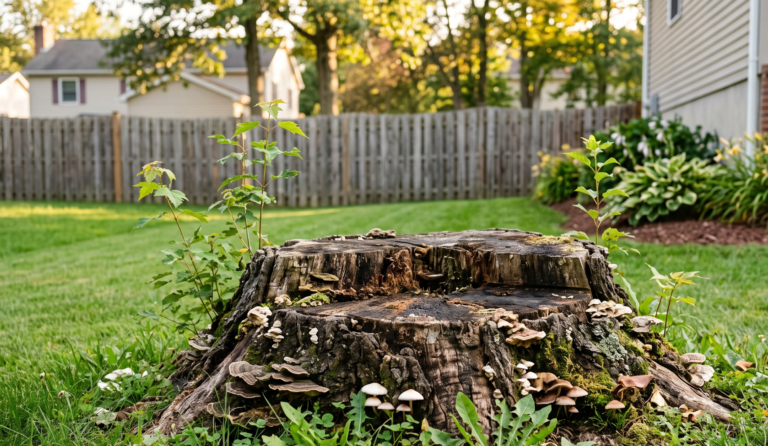
A: Bracket fungi, conks, or mushrooms growing on the root flare or lower trunk are visual indicators of advanced internal wood decay. While not every mushroom means an immediate collapse, it signifies that structural anchor roots or heartwood may be compromised, warranting an urgent professional hazard inspection.
Q: How do I tell if a leaning tree is dangerous or just naturally tilted?
A: A tree that grew at an angle over decades usually develops compensatory curves in the trunk and heavy anchor roots on the tension side. A freshly leaning tree, accompanied by cracked, mounded soil or exposed root hair on the opposite side, indicates active root failure and requires emergency attention.
4. Structural Pruning Strategies: Preparing Canopies for Wind Resistance
Pruning for winter windstorm resilience is fundamentally different from aesthetic summer shaping. Done incorrectly—such as “topping” or severe “lion’s tailing”—pruning actually increases wind failure risk. Professional tree trimming by an ISA-certified arborist relies on sound arboricultural physics (ANSI A300 standards).
End-Weight Reduction
High-wind failure often occurs because the weight of foliage, ice, or snow is concentrated at the outermost tips of long branches. This creates an extreme lever-arm effect, multiplying torque at the branch union where it attaches to the trunk. Arborists perform end-weight reduction by making precise reduction cuts back to healthy, lateral parent branches that are at least one-third the diameter of the removed stem. This shortens the lever arm, significantly lowering the mechanical strain exerted during heavy buffeting.
Crown Thinning and Wind Permeability
A dense tree canopy functions like a canvas sail on a ship’s mast: it blocks the wind, absorbing maximum force and transferring it straight into the trunk and root plate. Through selective crown thinning, an arborist carefully removes a minimal percentage (rarely exceeding 15–20%) of interior, crossing, rubbing, and weak branches. This creates aerodynamic wind channels, allowing gale-force gusts to pass through the canopy with significantly reduced dynamic drag while preserving the tree’s health and food production.
Structural Cabling and Dynamic Bracing
Certain large, mature trees—such as historic sugar maples or legacy oaks in Greece—possess poor branch architecture (such as heavy co-dominant stems) that property owners do not want to remove entirely. In these circumstances, arborists install structural cabling and bracing systems. High-strength steel cables or dynamic synthetic support lines are placed in the upper two-thirds of the canopy to tether stems together. When winter winds whip the branches in opposite directions, the cable limits movement, distributing the dynamic shock load across the entire structure rather than letting one stem shear off.
Frequently Asked Questions
Q: Why is “tree topping” harmful before winter storms?
A: Tree topping cuts main leaders indiscriminately, creating large, open, flat wounds that quickly decay. Furthermore, it triggers a flush of weakly attached water sprouts that grow rapidly and snap off easily during moderate wind and snow events.
Q: What is the difference between crown thinning and lion’s tailing?
A: Crown thinning evenly distributes cuts throughout the canopy, maintaining balance and branch taper. Lion’s tailing strips away all interior foliage and leaves, leaving only a tuft of growth at branch tips, which shifts mechanical stress directly to branch ends and drastically elevates breakage risk.
Q: How do steel or synthetic cables protect a tree from wind damage?
A: Cables installed in the upper canopy connect two or more co-dominant trunks. They allow normal, flexible movement in light breezes but arrest extreme, divergent swaying during severe windstorms, preventing the structural fork from splitting open.
5. Root Zone Care and Winter Moisture Management
A tree’s stability during a winter gale is only as dependable as the root system anchoring it into the Monroe County soil. Healthy root management during the late summer and fall sets the foundation for cold-weather resilience.
Soil Aeration and Relieving Compaction
In many residential subdivisions throughout Greece and Rochester, heavy equipment during home construction compressed native subsoils into impermeable layers. Compacted soil prevents roots from penetrating deeply, forcing root systems to grow in a shallow, pancake-like layer across the top 12 inches of soil. Arborists utilize pneumatic soil excavation tools (air spades) to decompact the soil around the drip line without damaging sensitive roots. Loosening the soil allows structural roots to establish deeper vertical sinker anchors that resist soil shifting during windstorms.
Fall Hydration Strategy
While late fall frequently brings rain, dry autumn spells do occur. Drought-stressed trees enter winter with compromised vascular cells, making their wood far more brittle and susceptible to cold-temperature snapping. Giving mature trees deep, slow root soakings before the first ground freeze (typically mid-to-late November in Upstate New York) ensures cell turgor pressure remains optimal, helping branches retain their natural elastic bend during high-wind loading.
Mulching Done Right: Say No to “Mulch Volcanoes”
A proper 2-to-4-inch layer of organic, aged wood chip mulch applied over the root zone insulates root tissue from harsh freeze-thaw cycles and helps stabilize soil moisture levels. However, homeowners must avoid the dreaded mulch volcano—piling mulch up against the trunk flare. Mulch touching the bark creates an ideal moist environment for fungal pathogens and wood-boring insects, decaying the structural wood at the trunk base and leading to premature tree failure during winter storms. Always keep mulch pulled 4 to 6 inches back from the trunk base, exposing the natural root flare.
Frequently Asked Questions
Q: Does watering trees in the late fall really help them withstand winter winds?
A: Yes. Adequate soil moisture before the ground freezes allows tree cells to maintain hydraulic turgor pressure. Well-hydrated wood retains its cellular elasticity, allowing branches to flex under wind and ice loads rather than snapping like dry kindling.
Q: How does a “mulch volcano” contribute to tree failure in windstorms?
A: Piling mulch directly against the bark keeps moisture trapped against the trunk flare. Over time, this softens the bark and fosters fungal rot at the basal anchor zone, undermining the tree’s structural foundation and paving the way for whole-tree failure.
Q: Can compacted soil be corrected without killing existing tree roots?
A: Yes. Arborists use pneumatic tools known as air spades to fracture compacted soil with supersonic air streams. This decompresses the soil and incorporates organic material without stripping, tearing, or bruising delicate tree root systems.
6. Navigating Permits, Property Lines, and Utilities in Greece & Rochester
Winter storm mitigation work often involves considerations that go beyond botany—specifically, municipal codes, property boundary laws, and overhead utility lines.
Rochester Gas & Electric (RG&E) Clearances
Never attempt to trim or remove trees growing near overhead power lines. If strong winds blow tree branches into utility wires along your street or service drop, dangerous arcing, fires, and localized power outages can occur. RG&E maintains specific clearance rights for primary utility lines. If you notice hazardous limbs leaning across primary conductors, contact the utility immediately. For lines connecting directly to your home (service drops), professional, line-clearance-qualified arborists must handle pruning to avoid life-threatening electrical hazards.
New York State Neighbor Law and Overhanging Limbs
A common source of suburban dispute in Greece, Irondequoit, and Gates is an aging or dead tree positioned near a property boundary line. Under New York State common law, you generally have the right to trim branches and roots that encroach across your property line, but only up to the boundary line itself and provided your trimming does not fatally damage or destabilize the tree.
If your neighbor has a dead, decaying, or visibly hazardous tree leaning toward your home, notifying them in writing (via certified mail) creates a clear record of their awareness. Under New York law, if a property owner has documented notice that their tree is a hazard and fails to take corrective action, they may be found liable for negligence if that tree crashes onto your property during a subsequent storm.
Municipal Street Trees and Shoreline Regulations
- Town of Greece Right-of-Way Trees: Trees situated within the public right-of-way (often the strip between the sidewalk and curb, or within designated utility easements) are typically managed by the Town of Greece Department of Public Works. Do not remove or heavily alter a town tree without prior municipal consultation.
- Lakefront & Wetland Buffer Zones: Properties bordering the Lake Ontario shoreline, Buck Pond, Long Pond, Cranberry Pond, or Braddock Bay may fall under New York State Department of Environmental Conservation (NYSDEC) Coastal Erosion Hazard Area or freshwater wetland regulations. Significant clearing or grading within protected shoreline buffers often requires specialized review to protect coastal soil stability.
Frequently Asked Questions
Q: Who pays for tree damage if my neighbor’s tree falls on my house in Greece, NY?
A: Under standard New York insurance principles, damage caused by an act of nature is typically filed under your own homeowner’s insurance policy, regardless of who owned the tree trunk. However, if you sent prior written notice to your neighbor documenting that their tree was dead/hazardous and they failed to act, they may be held legally liable for negligence.
Q: Am I allowed to trim branches hanging over my fence from a neighbor’s yard?
A: Yes, under New York State law, you may prune overhanging limbs up to your exact property line. However, you cannot cross the boundary, enter their yard without permission, or prune the tree so aggressively that you kill or structurally destabilize it.
Q: Who is responsible for tree limbs touching the electrical line running to my house?
A: Utility companies like RG&E typically manage primary transmission wires along the street, but the homeowner is generally responsible for clearing branches touching the service drop line running from the street pole directly into the home weatherhead. This pruning should only be performed by a qualified, insured line-clearance arborist.
7. Actionable Pre-Winter Tree Care Checklist for Property Owners
Take this checklist into your yard during mid-autumn to evaluate your property’s winter storm readiness:
- 360-Degree Ground Inspection
- Walk your property perimeter and view every large tree from multiple angles.
- Look for sudden structural leans or mounded, cracked dirt around the root flare.
- Trunk and Fork Examination
- Check main branch forks for sharp “V” shapes and vertical seam cracks.
- Look for sawdust-like frass, deep cavities, weeping sap, or fungal conks (bracket mushrooms).
- Canopy Assessment
- Spot hanging, fractured, or dead limbs (“widowmakers”) suspended in the crown.
- Identify branches touching or crossing within 10 feet of your roof, gutters, or chimney.
- Utility Line Verification
- Inspect service drop wires running from the street pole to your home weatherhead.
- Check if tree branches are rubbing against or weighing down these cables.
- Ash Tree Inventory
- Confirm whether any green or white ash trees remain untreated on the property.
- If dead or displaying severe woodpecker damage (“flecking”), schedule immediate removal.
- Professional Arborist Consultation
- Schedule a comprehensive assessment with an ISA-certified arborist for mature shade trees.
- Complete high-priority structural pruning, weight reduction, and cabling before the first freeze.
Frequently Asked Questions
Q: When should I complete my pre-winter tree checklist in Rochester?
A: The optimal window is mid-to-late autumn (October through late November). At this point, deciduous trees have dropped their leaves, making defects and structural cracks fully visible before the ground freezes and heavy snow arrives.
Q: How far away should tree branches be kept from my roof and gutters?
A: Limbs should ideally maintain a clearance of at least 8 to 10 feet from roofs, siding, and gutters. This prevents branches from scraping shingles during high winds and stops heavy snow-laden limbs from resting directly on your roof structure.
Q: What is a “widowmaker” in tree service terms?
A: A “widowmaker” is an industry term for a broken, dead, or detached branch that is hanging precariously in the upper canopy. High winds or freezing rain can dislodge these limbs without warning, posing a life-threatening hazard to anyone underneath.
8. What to Do When a Storm Hits: Safety and Emergency Tree Services
Even with diligent preparation, extreme weather anomalies—such as a 75 mph November seiche or a catastrophic December ice storm—can cause unforeseen structural failures. Knowing how to react in the immediate aftermath protects your family from secondary hazards.
1. Maintain Extreme Distance from Fallen Wires
If a tree or heavy branch brings down overhead utility lines in your yard, assume the wires are energized and deadly. Keep family members and pets at least 35 feet away. Call 911 and report the downed wire to Rochester Gas & Electric immediately. Do not attempt to move branches off wires, fences, or vehicles yourself.
2. Avoid Standing Under Damaged Canopies
Trees that suffer partial branch tears or canopy fractures are under massive, unstable mechanical tension. Partially detached limbs—often termed “hangers” or “widowmakers”—can slip and drop hours or days after the wind subsides. Stay clear of damaged trees until a professional crew can secure the canopy using aerial lifts or rigging systems.
3. Document the Scene for Insurance Claims
Before any clean-up crew begins work, take comprehensive, high-resolution photographs and videos of the damage from safe angles. Capture:
- The failed tree and its base (showing root upheaval or trunk fracture).
- The direct physical impact on your home, roof, shed, vehicle, or fence.
- Any broad-angle shots demonstrating property context.
Standard homeowners insurance policies typically cover the cost of removing a tree that falls on an insured structure, as well as the associated repairs. They generally do not cover removal if a tree falls harmlessly in an open lawn without damaging an insured asset, though terms vary by provider.
4. Rely Exclusively on Fully Insured, Certified Professionals
Following major weather emergencies, transient, door-to-door “tree cutters” frequently flood neighborhoods across Monroe County, offering cheap, cash-only cleanup. Utilizing unlicensed or uninsured operators exposes homeowners to severe financial and legal liabilities. If an uninsured worker falls or drops a limb through your roof, you may be held liable under New York labor law.
Always ensure the company you hire provides:
- Proof of active workers’ compensation and general liability insurance certificates sent directly from their insurance broker.
- Active International Society of Arboriculture (ISA) credentials.
- Professional rigging equipment (cranes, bucket trucks, and commercial chippers) capable of handling hazardous, tensioned wood safely.
Frequently Asked Questions
Q: What is the first thing I should do if a tree falls on my house during a storm?
A: Ensure the immediate physical safety of everyone inside. Evacuate the affected area of the house, check for electrical arcing or gas leaks, call 911 if power lines are compromised, and then call a 24/7 emergency tree service company to stabilize and tarp the structure.
Q: Will my homeowner’s insurance cover tree removal if no damage occurred to my house?
A: Typically, no. Most insurance carriers only cover the cost of tree removal if the tree lands on an insured structure (such as your home, garage, shed, or fence) or blocks a necessary driveway. If it falls harmlessly across your lawn, cleanup is usually out-of-pocket.
Q: Why shouldn’t I hire an unlicensed tree service after a storm?
A: Tree work on storm-damaged trees is exceptionally dangerous due to structural tension and compression. If an uninsured contractor is injured on your property or drops a log through your ceiling, you could be held personally liable for medical bills and property damages.
9. Finding a Certified Tree Service Near You: Our Monroe County Service Areas
When a severe lake-effect blizzard blows through or 65 mph gusts split a mature maple across your driveway, you cannot afford to wait hours for an out-of-county crew to commute across Western New York. If you are searching for an experienced, fully insured tree service near you, Greece Tree Service provides rapid storm response, hazard risk evaluations, and preventative trimming across our immediate shoreline, bays, and suburban neighborhoods.
Because Google’s proximity algorithms (such as the Possum filter) match searchers with verified local operations closest to their real-world location, our crews are strategically dispatched daily across Monroe County to guarantee fast response times:
- Town of Greece (14612, 14616, 14626): North Greece, Grandview Beach, Braddock Bay, Edgemere Drive, Maiden Lane, Long Pond Road, Dewey Avenue, English Road, Latta Road, and Route 104.
- Lake Ontario Shoreline & Rochester Neighborhoods: Charlotte Lakeshore, Beach Avenue, Irondequoit (14617), Hilton (14468), Parma, Spencerport (14559), Gates (14624), and Northwest Rochester.
Office Service Map
Frequently Asked Questions
Q: How quickly can Greece Tree Service respond to an emergency tree service call near me?
A: For active life-safety hazards, downed power cables, or trees that have breached a living space or driveway, our emergency response team operates 24/7 and aims to arrive on-site within hours across Greece and surrounding Monroe County neighborhoods.
Q: Do you offer free on-site inspections for homeowners in the 14612, 14616, and 14626 areas?
A: Yes. We provide 100% free, no-obligation on-site evaluations for tree trimming, structural weight reduction, cabling, and removals throughout the Town of Greece and surrounding towns.
Q: Why does choosing a tree service with a physical Greece address matter for storm prep?
A: Out-of-area contractors lack familiarity with Lake Ontario’s high-velocity wind patterns, local municipal right-of-way regulations, and Monroe County soil conditions. A local arborist can accurately assess wind fetch exposure on coastal properties and deploy equipment quickly before severe winter weather closes roads.
10. Protect Your Monroe County Landscape with Greece Tree Service
When cold winds start whipping off Lake Ontario, having confidence in the stability of your trees provides priceless peace of mind. Taking preventative action today avoids costly, dangerous emergency calls in the dead of winter.
At Greece Tree Service, our team of ISA-certified arborists has proudly served the Town of Greece, Rochester, Charlotte, Hilton, and surrounding Monroe County communities for years. Whether you need proactive structural pruning, tree cabling, hazardous limb removal, or a pre-winter tree health assessment, we combine state-of-the-art rigging equipment with deep arboricultural expertise to keep your landscape resilient and your home protected.
Call Greece Tree Service today at +1 585-628-8744 or visit https://greecetreeservice.com/ to schedule your on-site winter hazard inspection and free estimate.