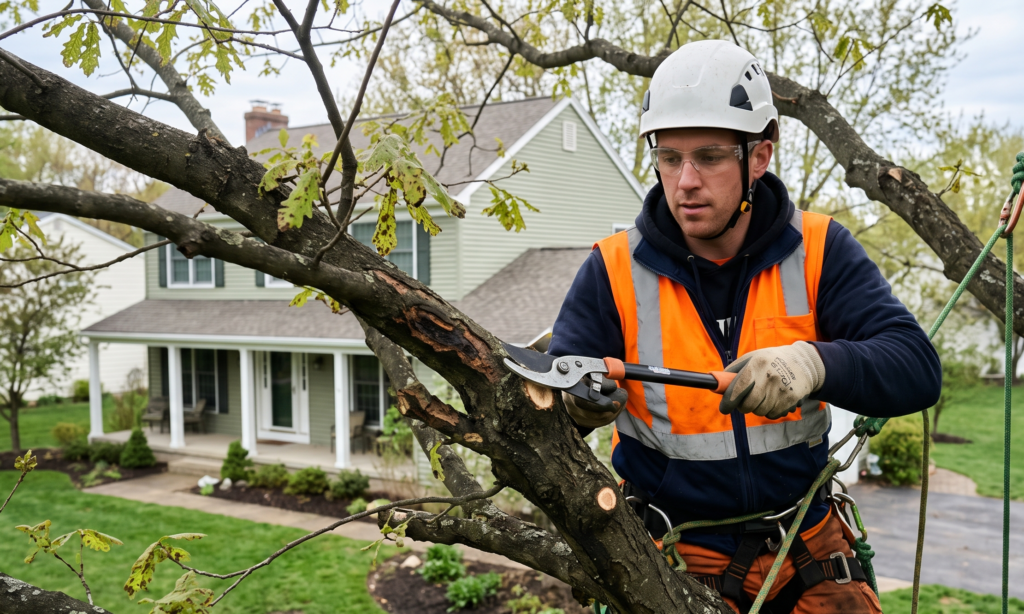
Living along the southern shore of Lake Ontario means our regional urban forest enjoys rich glacial soil and abundant seasonal rainfall; however, these identical environmental triggers also drive widespread Upstate NY tree diseases, making professional pruning to help prevent them a critical defense for local homeowners. Throughout Greece, NY, and neighboring Monroe County communities from Braddock’s Bay down to the Ridge Road corridor, fungal pathogens like apple scab and Diplodia tip blight thrive in our moisture-dense microclimates. Without proactive structural canopy thinning and the surgical removal of blighted shoots, residential shade trees quickly fall prey to systemic vascular decline, leaf dieback, and irreversible branch rot.
Preserving the health of our local canopy requires recognizing the biological warning signs before structural stability is permanently compromised. Whether you are dealing with an ornamental crabapple dropping leaves in mid-summer or an old Austrian pine showing dead terminal needles, targeted branch removal works as plant health surgery. Pruning rebalances the tree’s natural defense systems, restores sunlight penetration, and stops spores from migrating deeper into structural heartwood.
Frequently Asked Questions
Can tree diseases jump property lines between suburban yards in Greece, NY?
Yes. Fungal spores travel continuously on cross-lake winds, while bacterial blights are easily moved across fences by pollinating bees, birds, and driving rain.
Does structural pruning eliminate the need for chemical spraying?
In many cases, yes. Opening the canopy to increase wind circulation and sunlight changes the microclimate so drastically that fungal spores cannot remain wet long enough to germinate, drastically reducing or eliminating the need for recurring chemical fungicides.
Why do newly planted suburban trees struggle with blights more than native woodlands?
Suburban trees often face compacted clay soils, restricted root zones, and mechanical lawnmower damage, leaving them stressed and far less capable of naturally walling off infections than undisturbed woodland trees.
The Upstate NY Climate Factor: Why Our Regional Trees Are Vulnerable
Trees growing in Greece and surrounding Monroe County exist in a demanding environmental pocket shaped heavily by Lake Ontario’s direct meteorological influence.
1. Persistent Lake-Effect Humidity and Foliar Wetness
Pathogenic fungi require free-standing water on foliage for sustained periods—frequently between 6 and 12 continuous hours—to germinate and pierce the protective epidermal cuticle. Because the Lake Ontario air mass keeps relative morning humidity elevated along the Edgemere Drive and Lake Ontario State Parkway corridors, leaves remain coated in dew long after sunup, giving spores the moisture window they need to take hold.
2. High-Density Glacial Silts and Heavy Clay Soils
Suburban developments throughout Greece generally sit upon dense, post-glacial lacustrine clay soils. These soils retain moisture long into late spring, restricting natural oxygen circulation around root zones (rhizosphere). Hypoxic roots cannot synthesize the vital phytoalexins and secondary compounds needed to fight off foliar blights, making the upper canopy vulnerable to secondary pathogen invasion.
3. Rapid Late-Winter Freeze-Thaw Cycles
Our regional late-winter climate frequently swings from 55°F sunny afternoons to sub-freezing lake blizzards within hours. These extreme temperature drops trigger radial contraction inside the trunk, splitting open the bark on south- and southwest-facing sides (frost cracks and sunscald). These open wounds provide immediate, unhindered access for wood-decay fungi like Ganoderma and airborne canker blights.
Frequently Asked Questions
How does living within two miles of Lake Ontario impact my tree care schedule?
Lakeshore moisture prolongs seasonal leaf wetness, meaning trees in coastal Greece require more frequent crown thinning to maintain adequate interior air velocity than trees further inland.
Can poor lawn drainage cause branch dieback in the upper crown?
Yes. Saturated clay soil rots the delicate feeder roots responsible for taking up moisture and micronutrients, causing systemic tip dieback throughout the upper crown.
Are frost cracks on maple trunks fatal?
Not immediately, but if left exposed, they invite secondary wood-decay fungi. Corrective dormant pruning reduces outer branch weight, helping the trunk direct its energy toward compartmentalizing the crack.
Five Destructive Tree Diseases Common in Upstate New York
Accurate diagnosis is the foundation of effective tree care. Applying generic treatments without identifying the specific pathogen can waste valuable time and accelerate canopy decline.
1. Apple Scab (Venturia inaequalis)
- Primary Hosts: Flowering crabapples, domestic apples, hawthorns, and mountain ash.
- Visible Symptoms: Appears as olive-drab, velvety spots on fresh spring foliage that darken into greasy, charcoal-colored lesions. Infected leaves turn chlorotic (yellow) and drop prematurely, frequently stripping trees bare by mid-summer.
- Transmission Mechanism: Overwinters in fallen leaf litter beneath the tree. Spring rain splashes spores upward into the lower crown, where dense branches trap humidity.
2. Diplodia Tip Blight (Diplodia sapinea)
- Primary Hosts: Austrian pine, Scots pine, Mugo pine, and occasionally Eastern white pine.
- Visible Symptoms: Emerging spring candles stunt and brown before fully elongating. Small, black fungal fruiting bodies (pycnidia) appear at the base of dead needles, and resin droplets bead along dead branch tips. Over successive seasons, branch dieback spreads from lower limbs upward.
- Transmission Mechanism: Spores are washed through the canopy by rain, entering needles through newly expanding tissue or insect wounds.
3. Fire Blight (Erwinia amylovora)
- Primary Hosts: Ornamental pears, flowering crabapples, mountain ash, and hawthorns.
- Visible Symptoms: Shoot tips wilt rapidly, turning deep reddish-brown or black as though scorched by fire, curling into a distinctive “shepherd’s crook. ” Amber bacterial ooze beads on infected bark during warm, damp spring mornings.
- Transmission Mechanism: Bacteria overwinter in branch cankers and are spread to spring blossoms by rain and pollinating insects, quickly traveling downward into main scaffold limbs.
4. Rhizosphaera Needle Cast (Rhizosphaera kalkhoffii)
- Primary Hosts: Colorado blue spruce and white spruce.
- Visible Symptoms: Needles on lower inner branches turn purplish-brown and shed over late summer and autumn, leaving branches bare with needles clinging only to the outer tips. Over several seasons, entire lower tiers die off completely.
- Transmission Mechanism: Fungal spores wash downward with rain, thriving in crowded privacy rows where tight spacing restricts air circulation.
5. Oak Wilt (Bretziella fagacearum)
- Primary Hosts: Red oaks, pin oaks, and black oaks (white oaks show mild tolerance).
- Visible Symptoms: Foliage wilts and bronzes rapidly from outer edges inward, starting at the top of the crown and causing dramatic defoliation within weeks.
- Transmission Mechanism: Nitidulid sap beetles carry fungal spores to open wounds between April and July; underground, the fungus spreads rapidly between neighboring trees via root grafts.
Frequently Asked Questions
Why are Austrian pines dying all over Monroe County?
Most are succumbing to Diplodia tip blight exacerbated by our humid lakeshore climate and poor clay drainage, which place non-native Austrian pines under chronic physiological stress.
How can I tell if my pear tree has fire blight or just dry leaves?
Fireblight turns leaves black and keeps them firmly glued to the twig, accompanied by a bent “shepherd’s crook” at the branch tip. Drought-scorched leaves typically turn brown and drop readily.
Can a blue spruce regrow needles lost to Rhizosphaera?
No. Conifers do not produce new needles on bare interior wood. Pruning halts the disease’s upward progress, protecting the remaining healthy canopy.
How Strategic Pruning Breaks the Pathogen Cycle
Pruning is far more than aesthetic shaping; it is an environmental intervention that fundamentally changes the crown’s microclimate, activating the tree’s natural defense systems.
1. Promoting Airflow and Accelerating Canopy Desiccation
Foliar fungi cannot infect dry leaves. By selectively thinning secondary branches and removing crossing interior limbs, air flows freely through the crown. This ensures morning dew and storm moisture evaporate well within the critical germination window.
2. Maximizing Solar UV Penetration
Solar ultraviolet radiation acts as a natural broad-spectrum disinfectant. Dense, neglected canopies create cool, shaded interior pockets where fungi flourish. Thinning opens vertical light windows through the outer shell, exposing interior stems and leaves to drying UV rays.
3. Surgical Removal of Inoculum Reservoirs
Canker-causing fungi and bacterial blights overwinter directly within dead twigs, branch stubs, and infected bark. Leaving them in place ensures millions of active spores are positioned directly above vulnerable spring growth. Pruning out these infected sections eliminates the pathogen source at the root.
4. Activating CODIT (Compartmentalization Of Decay In Trees)
Trees do not regenerate injured cells; they wall them off. Under the CODIT model, a tree builds chemical and physical barriers across four distinct walls to isolate decay:
- Wall 1: Halts vertical spread by plugging vascular xylem vessels.
- Wall 2: Halts inward spread using dense latewood growth rings.
- Wall 3: Halts lateral spread using ray cell barriers.
- Wall 4: The strongest barrier, formed by the cambium to seal off future new wood from infected tissue.
Proper cuts made just outside the branch collar allow Wall 4 to seal smoothly without opening structural pathways to interior rot.
Frequently Asked Questions
What is the branch collar, and why must it never be cut?
The branch collar is the swollen ring of trunk tissue at the base of the limb. It contains specialized chemical defense zones that seal the pruning cut. A flush cut destroys this collar, opening the trunk directly to decay.
How far behind visible disease should an arborist cut?
For systemic bacterial diseases like fire blight, cuts must be made at least 12 to 18 inches into healthy, non-stained wood to ensure no bacterial strands remain in the vascular stream.
Does heavy pruning stress a sick tree?
Yes, if done excessively. Removing more than 20–25% of a tree’s live canopy at once starves it of photosynthesized sugars. Sanitizing diseased wood should always be balanced against preserving photosynthetic area.
Professional Pruning Methodologies That Protect Trees
Targeted structural pruning must follow strict arboricultural rules to ensure the tree seals cleanly rather than developing structural tears or rot pockets.
| Pruning Operation | Target Limbs Removed | Primary Plant Healthcare Benefit | Ideal Seasonal Timing |
| Crown Cleaning | Dead, dying, diseased, and crossing branches. | Removes active pathogen reservoirs and prevents rot from reaching structural scaffolds. | Year-round; best in dormant winter. |
| Crown Thinning | Selective secondary branches across the outer canopy. | Increases interior wind speed, cuts humidity, and admits solar UV radiation. | Mid- to late winter. |
| Crown Raising | Lowest branch tiers clearing ground level. | Prevents soil-borne fungal spores from splashing up onto lower foliage. | Dormant season before bud burst. |
| Sanitary Canker Removal | Active localized bacterial or fungal branch lesions. | Stops systemic vascular spread down toward the main trunk. | Deep winter freezes (sub-freezing days). |
The Three-Cut Method: Preserving the Branch Collar
Whenever removing a branch larger than one inch in diameter, crews use the three-cut method to prevent heavy falling wood from stripping bark down the trunk:
- The Undercut: Make a cut upward from the bottom of the limb roughly 12 to 18 inches out from the trunk, cutting one-third through the branch. This stops bark from tearing downward.
- The Relief Cut: Cut downward from the top side of the branch, two to three inches farther out than the undercut. The branch will drop cleanly without tearing bark down the tree.
- The Finish Cut: Saw off the remaining stub cleanly, positioning the cut just outside the branch bark ridge and branch collar.
Frequently Asked Questions
What happens if a pruning cut tears the bark down the trunk?
Bark tearing destroys the cambium layer, preventing proper wound closure and leaving large swaths of heartwood exposed to wood-boring insects and airborne fungal spores.
Can I seal pruning cuts with black wound dressing or tar?
No. Modern arboricultural science shows that petroleum-based dressings and paints trap moisture inside the cut, accelerating fungal decay and interfering with the tree’s natural healing processes.
How can I tell if a contractor made a flush cut?
If the cut is completely flat against the trunk and removes the raised ring of bark at the branch base, it is a flush cut—a damaging practice that violates ANSI A300 standards.
Tool Sterilization: Preventing Human Vectoring of Tree Pathogens
One of the most common ways diseases spread through suburban neighborhoods is on unsterilized saws, loppers, and chainsaw chains. Pathogens like Erwinia amylovora (Fire Blight) and Bretziella fagacearum (Oak Wilt) cling to equipment, turning regular maintenance into accidental inoculation.
Professional tree care protocols demand rigorous tool hygiene:
- Disinfectant Solutions: Wipe down cutting blades with a 70% isopropyl alcohol solution or dip them in a specialized pine-oil solution between every cut when pruning diseased wood.
- Why Bleach Should Be Avoided: Common household bleach is corrosive. It pits carbon steel blades, dulls cutting edges, creates rough cuts, and releases noxious fumes.
- Sharpening and Surface Finish: Dull blades tear and crush plant tissue instead of slicing cleanly. Rough, crushed branch stubs hold water in surface fissures, creating ideal footholds for spore germination.
Frequently Asked Questions
Do pruning tools really need to be cleaned between every cut?
When dealing with active bacterial blights like fire blight, yes. Moving from an infected twig to a healthy limb without sanitizing can spread the bacteria throughout the entire canopy.
Can chainsaw chains be effectively disinfected?
Yes. Chains can be sprayed with isopropyl alcohol, though during high-risk windows (such as oak wilt season), major structural cuts on susceptible species should be avoided entirely.
Does household Lysol work to sanitize pruning shears?
Yes. Standard household disinfectant sprays containing quaternary ammonium compounds or high alcohol concentrations are effective alternatives for residential garden shears.
Seasonal Timing: Upstate New York Pruning Calendars
Pruning during the wrong biological window can turn a preventative maintenance job into a serious health crisis for your trees.
Late Winter (January through Mid-March): The Optimal Window
Late winter is the safest and most effective window for structural canopy work across Monroe County.
- Zero Fungal Activity: Temperatures well below freezing keep fungal spores and bacterial populations dormant, leaving open cuts safe from infection.
- Full Branch Visibility: Without leaves in the way, arborists can easily spot crossing limbs, hidden trunk fissures, bark cankers, and weak V-shaped unions with included bark.
- Rapid Spring Sealing: Come April, stored starches push up from the roots, and the tree immediately funnels that spring energy into sealing cuts with healthy woundwood.
The Strict Oak and Elm Summer Pruning Ban
To prevent the spread of oak wilt and Dutch elm disease, red and white oaks, as well as American elms, must never be pruned between April 1st and July 31st in Western New York. During this warm window, sap flowing from fresh pruning wounds attracts sap-feeding nitidulid beetles carrying lethal fungal spores directly from infected woodland trees.
Frequently Asked Questions
What should I do if an oak limb breaks during a June thunderstorm?
Make a clean cut just outside the branch collar immediately, then apply an approved arborist wound paint right away. This is one of the few exceptions where wound paint is recommended, as it blocks the scent of sap from attracting beetles.
Why shouldn’t I prune deciduous shade trees in October?
In autumn, wood-decay fungi release millions of spores, while trees are entering dormancy and lack the metabolic energy needed to begin sealing cuts.
Can maples be safely pruned in late winter if they bleed sap?
Yes. Maple sap flow in late winter is simply root water under osmotic pressure; it looks dramatic, but it does not harm the tree or drain its energy reserves.
Integrated Preventive Care for Greece and Rochester Landscapes
Pruning is only one component of comprehensive tree care. True long-term protection integrates clean sanitation and good soil management
- Raking and Sanitizing Debris: Fungi like Apple Scab and Rhizosphaera Needle Cast overwinter within fallen leaf and needle litter. Leaving fallen leaves under the drip line ensures spring rain will splash those same spores back up into the canopy. Rake, bag, and remove blighted debris before winter sets in.
- Exposing the Root Flare: Many suburban landscapes in Greece suffer from deep planting and excess mulch. Piling mulch high against the trunk bark traps moisture, suffocating root systems and inviting Phytophthora root and collar rot. Ensure the basal root flare sits cleanly at grade.
- Targeted Soil Nutrition: Avoid applying fast-release lawn fertilizers containing high nitrogen under your tree’s canopy. Nitrogen forces rapid, succulent vegetative growth with thin cell walls that are easily penetrated by fire blight bacteria and powdery mildew. Focus instead on aeration and balanced organic amendments.
Frequently Asked Questions
Can I compost diseased crabapple leaves in my home garden?
No. Most home compost piles do not reach the high internal temperatures (140°F+) required to kill fungal spores like apple scab, meaning the finished compost will simply spread the disease.
How deep should mulch be around mature shade trees?
Keep mulch 2 to 4 inches deep, spread in a wide, flat ring out to the drip line, and make sure it stays pulled back 3 to 6 inches away from the trunk.
Does lawn aerating benefit nearby tree roots?
Yes. Core aeration breaks up dense Monroe County clay soils, improving oxygen transfer and water infiltration to tree feeder roots.
Looking for an Expert Tree Service Near You in Greece, NY?
If you are searching for an insured, professional tree service near me in Greece or the greater Rochester area, you need a team that knows our specific local soils, township tree regulations, and Lake Ontario weather patterns. At Greece Tree Service, our crews work across Monroe County diagnosing diseased limbs, thinning overcrowded crowns, and taking down hazardous trees before storm season hits.
Neighborhoods & Dispatch Corridors We Serve Daily:
- North Greece & Shoreline: Grand View Heights, Braddocks Bay, Edgemere Drive, Lowden Point, and along the Lake Ontario State Parkway.
- Central & South Greece: Ridge Road West (Route 104), Dewey Avenue corridor, Maiden Lane, Stone Road, English Road, and Long Pond.
- Bordering Monroe County Communities: Swift dispatch to Charlotte, Gates, Chili, Irondequoit, and northwest Rochester suburbs.
Why Local Property Owners Trust Our Teams:
- Lake-Shore Canopy Experience: We understand the high humidity, wet clay soils, and wind shears that make coastal Greece trees prone to foliar blights and root decline.
- Low-Impact Yard Equipment: From compact aerial lifts that fit through backyard gates to specialized turf mats, we reach tall canopies without damaging lawns or driveways.
- Emergency Storm Readiness: When heavy lake-effect snows or severe summer gales knock limbs onto roofs or power lines, our local crews are ready to respond quickly.
Frequently Asked Questions
Do you provide free on-site tree evaluations in Greece, NY?
Yes. We provide clear, written estimates detailing pruning needs, disease mitigation, and hazardous tree removals for residential and commercial properties.
Are you fully insured for large tree removals over homes?
Yes. We carry comprehensive general liability and workers’ compensation coverage to protect your home and property during every phase of work.
Can you help determine if a town permit is needed to remove a street tree?
Yes. We regularly work within Town of Greece municipal codes to determine whether a tree sits on private property or within the town right-of-way.
Knowing When to Call an ISA-Certified Arborist
While property owners can easily handle basic low-branch pruning with hand tools, working in the upper canopy requires specialized safety rigging, commercial-grade equipment, and certified expertise. Climbing ladders with chainsaws or cutting heavy limbs under tension involves serious, life-threatening risks.
Professional arborists bring:
- Accurate Pathological Identification: Distinguishing between superficial seasonal leaf spot and aggressive vascular wilt protects you from spending money on unneeded removals.
- Advanced Rigging & Safety Standards: Using ANSI-compliant ropes, friction brakes, and bucket trucks lets crews dismantle heavy limbs in tight spaces without damaging homes, fences, or landscapes.
- Comprehensive Tree Risk Assessments: Checking for internal decay, hollow pockets, and root defects helps determine whether a tree can be saved through cabling and pruning or needs safe, controlled removal.
Frequently Asked Questions
What is an ISA-Certified Arborist?
An arborist credentialed by the International Society of Arboriculture who has passed rigorous exams covering tree biology, safety, diagnosis, and maintenance and maintains active continuing education credits.
Can cabling save a split tree?
In many cases, installing high-strength steel cables in the upper canopy relieves tension on weak V-shaped unions, stabilizing the tree alongside corrective pruning.
What should I do if a tree branch is touching a power line?
Stay well clear and call your local utility company immediately. Never attempt to prune branches near utility lines yourself.
Invest in Your Canopy’s Resilience
Trees are living structural features of our homes. They cool our neighborhoods during hot summer days, provide shelter from biting winter winds, supply critical urban wildlife habitat, and substantially boost residential curb appeal and property values throughout Greece. Don’t wait until foliage wilts, needles drop, or heavy branches snap over your roof. By spotting common regional diseases early and keeping up with proactive structural pruning, you can protect your landscape investment, keep your family safe, and enjoy a vibrant canopy for decades to come.