Mature trees add shade, beauty, and curb appeal to any home or commercial property, but a severely diseased or structurally compromised tree is an active liability. Knowing the warning signs a tree is dead can protect your roof, vehicles, power lines, and family from catastrophic property damage. While seasonal changes often cause healthy deciduous trees to drop foliage, an unaddressed dying specimen loses its structural elasticity quickly. In Western New York, fluctuating lake-effect weather, freeze-thaw cycles, and heavy windstorms turn brittle timber into an immediate falling hazard. When a tree reaches irreversible decline, prompt, professional tree removal is the only safe solution.
1. Peeling Bark, Deep Trunk Cracks, and Cavities
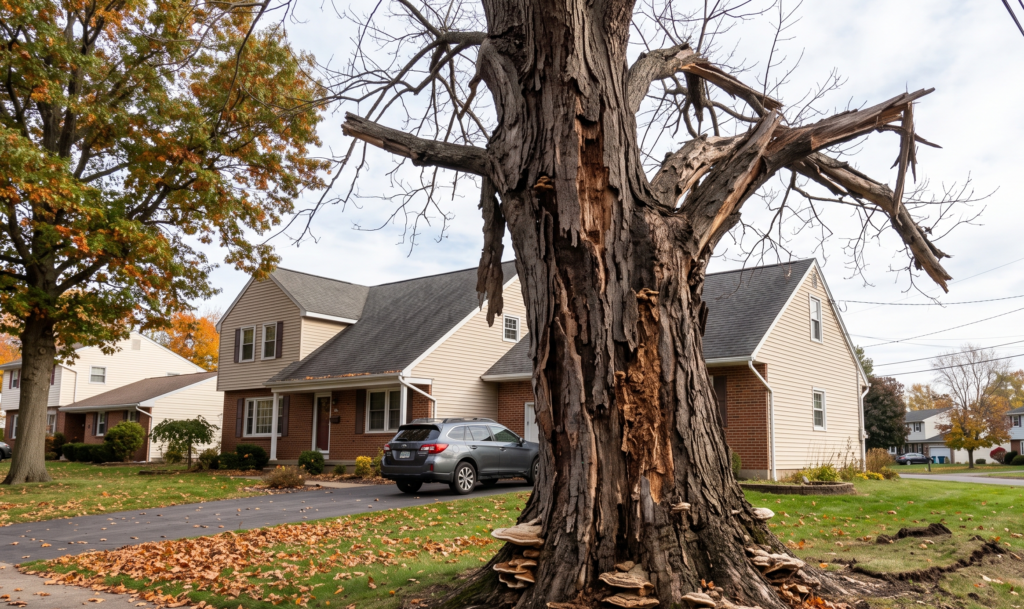
A tree’s bark functions as its primary defense against pests, fungal pathogens, and weather extremes. While some species—like birch, sycamore, or shagbark hickory—naturally shed thin outer layers, large sheets of missing bark indicate severe vascular damage.
When cambium tissue dies beneath the exterior surface, the tree can no longer circulate moisture and nutrients between the roots and the upper canopy. Look closely for:
- Extensive bare spots: Areas where bark falls away and leaves smooth, bone-dry wood exposed underneath.
- Vertical seams and fissures: Deep, vertical splits running down the main trunk indicate internal structural failure. Frost cracking and severe wind torque often widen these splits until the trunk snaps.
- Hollow trunks and nesting cavities: While small hollows can host wildlife, a trunk with more than one-third of its interior decayed lacks the tensile strength to withstand high-wind events.
Frequently Asked Questions
Q: Does peeling bark always mean my tree is dead?
A: Not necessarily. Some trees, such as river birches and sycamores, naturally exfoliate bark. However, if the bark peels away to expose dry, brown, or brittle inner wood without fresh green bark underneath, the vascular tissue in that section has died.
Q: Can a tree survive with a large hollow cavity in its trunk?
A: A tree can remain alive with a minor cavity if the outer ring of sapwood is intact, but if more than 30% to 35% of the trunk’s diameter is hollow or rotten, its structural integrity is severely compromised and poses a significant falling hazard.
2. Fungal Shelf Mushrooms and Conks at the Trunk Base
Fungi are nature’s decomposers; they feast almost exclusively on dead organic matter. If you spot bracket fungi, shelf mushrooms, or large fungal conks protruding from the base of the trunk or along primary root flares, the core of the tree is actively rotting.
Common structural rot fungi (such as Ganoderma or honey fungus) digest cellulose and lignin—the fibrous proteins that keep wood rigid. Once fungal fruiting bodies become visible externally, internal decay has typically been advancing for months or years. A tree that appears solid from fifty feet away might actually be a hollow wooden cylinder held up only by a thin layer of living tissue. Root rot prevents the tree from anchoring itself firmly in saturated soil, exponentially increasing the risk of sudden uprooting.
Frequently Asked Questions
Q: Can fungicide spray or soil treatments cure trunk mushrooms?
A: No. Fungal conks and mushrooms on the trunk or root flare are fruiting bodies of widespread internal decay. By the time they appear externally, the fungus has already consumed substantial wood fiber inside, which cannot be reversed with chemicals.
Q: Are mushrooms growing in the grass near the tree also a bad sign?
A: Mushrooms scattered randomly in the lawn are often harmless decomposers of thatch or buried mulch. However, if mushrooms form a direct ring or concentrated clusters along the tree’s primary root line, they often indicate subterranean root decay.
3. Persistent Canopy Dieback and Brittle “Snap-Test” Twigs
One of the clearest visual indicators of tree mortality is canopy dieback. During spring and summer, healthy trees burst with dense, vibrant foliage. If an entire section of the upper crown remains bare while neighboring trees are fully leafed out, the tree is failing.
Even during late autumn and winter dormancy, you can perform a simple field check:
The Scratch and Flex Test
- Choose small branch tips: Select thin exterior twigs from several quadrants around the canopy.
- Bend the twig: A healthy branch flexes smoothly under moderate pressure due to internal hydration. A dead twig snaps cleanly with an audible crack.
- Scratch the outer layer: Use a thumbnail or pocket knife to lightly scrape back the top layer of bark. Healthy wood reveals a vivid green, moist cambium layer underneath. Dead wood shows dry, brittle, brown or gray fiber.
If brown, brittle twigs dominate more than half of the canopy, or if dead leaves cling to the branches out of season without dropping naturally, circulation has stopped completely.
Frequently Asked Questions
Q: What does it mean if dead, brown leaves stay attached all through winter?
A: Some juvenile oaks and beeches hold dead foliage naturally (a trait called marcescence). In other species, dead brown leaves clinging across an entire branch often indicate a sudden failure in the vascular system that prevented the tree from forming the normal abscission layer to shed them.
Q: How much canopy dieback can a tree survive?
A: Generally, if more than 50% of the tree’s canopy has died off, recovery is extremely unlikely. The remaining living tissue rarely produces enough energy through photosynthesis to sustain the root system and defend against secondary pests.
4. Sudden, Uncorrected Leaning with Soil Heaving
Trees rarely grow in perfect symmetry, and a natural, gradual lean developed over decades is usually stable as the root system compensates. However, a sudden or worsening lean represents an arboricultural emergency.
Inspect the ground directly opposite the direction of the lean:
- Soil mounding or heaving: A raised mound of soil or exposed roots breaking through the lawn indicates that the structural anchor roots have sheared or pulled free from the subsoil.
- Ground sinkholes: Soft, spongy soil directly adjacent to the root plate often points to subterranean root rot or soil compaction collapse.
- Exposed anchor roots: Broken taproots sticking out of fresh dirt indicate the tree is actively in the process of toppling.
A leaning tree whose root plate is lifting should never be approached or climbed. High wind or rain saturation can cause total collapse without warning.
Frequently Asked Questions
Q: Can a suddenly leaning tree be staked or cabled back into position?
A: Mature trees with a sudden lean cannot be saved with cables or stakes. A sudden shift indicates root plate failure or broken anchor roots; attempting to straighten or anchor it creates a severe structural hazard.
Q: How do I tell the difference between a natural lean and a hazardous lean?
A: Natural leans develop slowly over years; the tree’s trunk often curves upward toward sunlight, and the ground around the base remains completely flat. A hazardous lean happens suddenly, leaves the trunk straight off-axis, and creates soil heaving or cracking on the opposite side.
5. Extensive Insect Infestation and Woodpecker Damage
Insects and wood-boring pests target stressed, declining, and dead trees. When a tree’s immune system collapses, insects quickly move in to feed and lay eggs.
Warning signs of severe pest colonization include:
- Boring dust (frass): Fine, sawdust-like powder collecting in bark crevices or piled around the root base.
- Exit holes: Small D-shaped or round exit holes scattered across the bark, often signaling emerald ash borer, bark beetles, or carpenter ants.
- Aggressive woodpecker activity: Woodpeckers do not drill healthy, dense wood without reason; they excavate trees riddled with insect larvae. Large rectangular cavities or heavy wood-stripping (flecking) mean the tree interior is already thoroughly infested and compromised.
Frequently Asked Questions
Q: Are woodpeckers the cause of my tree dying?
A: No. Woodpeckers are secondary indicators. They drill and peel bark because they hear and smell larvae, carpenter ants, or beetles living beneath the surface. The insects moved in because the tree was already compromised.
Q: Will an insecticide treatment save an ash tree showing heavy flecking?
A: If an ash tree has lost more than 30% to 50% of its canopy and exhibits significant woodpecker flecking from emerald ash borer larvae, systemic insecticide injections are rarely effective. Removal is typically the safest course of action.
Evaluating the Risks: Dead vs. Dying Trees
| Diagnostic Check | Dormant / Stressed Tree | Dead Tree (Requires Removal) |
| Scratch Test | Green, moist cambium beneath bark | Brown, brittle, dry interior wood |
| Branch Flexibility | Bends with resistance | Snaps easily with light pressure |
| Bark Condition | Firmly attached; species-appropriate texture | Sloughing off in large sheets; deep vertical fissures |
| Fungal Growth | Occasional surface lichen or moss | Shelf conks and mushrooms rooted into trunk base |
| Root Plate | Stable, level grade surrounding trunk | Heaved soil, sheared roots, visible ground tilt |
Frequently Asked Questions
Q: How long can a dead tree safely stand before it falls?
A: There is no predictable timeline. A dead tree can fall within days or stand for months, depending on moisture, wood rot velocity, and local weather patterns like high winds or heavy snow. However, each day it stands, the wood dries out and becomes more hazardous.
Q: Does homeowner insurance cover the removal of a dead tree before it falls?
A: Most standard policies do not cover preventative tree removal. However, if a known dead tree falls onto a structure, insurance adjusters may investigate whether negligence was involved, which could complicate claims.
Why DIY Dead Tree Removal Is Extremely Dangerous
Taking down a living tree requires precise calculations, but cutting down a dead tree introduces unpredictable variables that jeopardize even seasoned DIYers:
- Unpredictable hinge wood: Safe felling relies on creating a notch and a controlled directional hinge. Dead wood lacks structural integrity; it frequently shatters, pivots erratically, or kicks back off the stump.
- “Widowmakers”: Dead overhead limbs loosen without warning. The vibration of a chainsaw or the impact of a wedge can dislodge heavy upper branches directly onto the operator below.
- Internal decay pockets: A chainsaw bar can suddenly bind or plunge through hollow rot pockets inside the trunk, causing dangerous kickback.
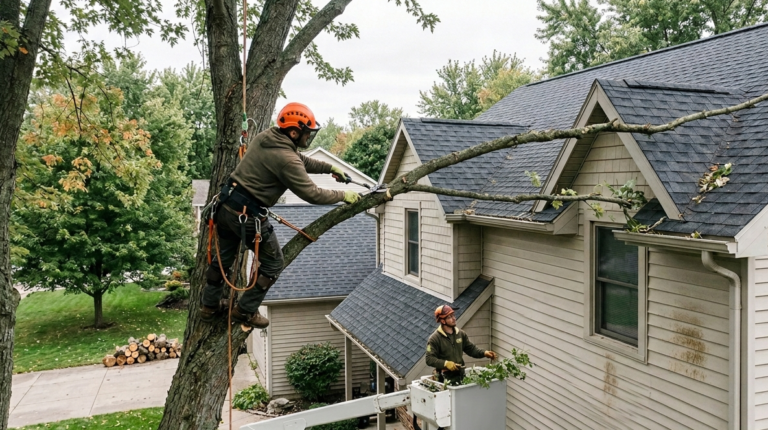
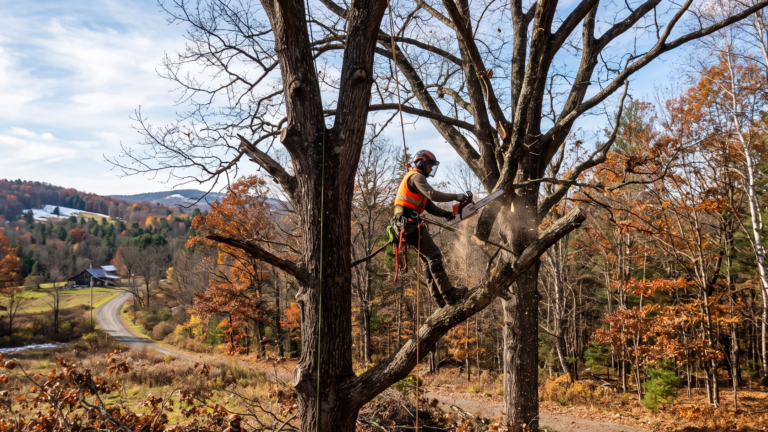
Licensed arborists utilize specialized rigging systems, aerial lifts, and directional winches to dismantle hazardous trees systematically from the top down, keeping nearby structures and power utilities completely safe.
Frequently Asked Questions
Q: Why shouldn’t a climber use standard spurs on a dead tree?
A: Dead bark and decayed sapwood cannot reliably hold climbing gaffs (spurs). The wood can shear off under the climber’s weight, leading to severe falls. Professionals use bucket trucks, cranes, or MEWPs (mobile elevating work platforms) for brittle removals.
Q: What is a “widowmaker” in tree care?
A: A widowmaker is an overhead branch that is dead, broken, or precariously lodged in the upper canopy. The slightest vibration from ground cuts or wind can cause it to drop unexpectedly, posing fatal risks to anyone beneath.
Looking for Certified Dead Tree Removal Near You?
When an unstable tree begins leaning toward your home or dropping limbs after a Monroe County windstorm, searching for “emergency tree removal near me” means finding a dependable local crew equipped to secure your property immediately.
At Greece Tree Service, our crew provides professional hazard evaluations, complete tree removals, stump grinding, and crane-assisted takedowns across the greater Rochester metro area. Whether your property is situated along Ridge Road, Latta Road, Dewey Avenue, Long Pond Road, or close to the Lake Ontario shoreline, we handle every tier of tree risk with commercial-grade rigging and certified safety protocols.
- Primary Service Areas: Greece (14612, 14616, 14626), Rochester (14615, 14606), Gates, Hilton, Irondequoit, Spencerport, Hamlin, and North Chili.
- Key Landmarks in Our Daily Route: Braddock Bay Park, Badgerow Park, English Village, The Mall at Greece Ridge, and the Lake Ontario State Parkway corridor.
Locate Greece Tree Service On Google Maps
Greece Tree Service
📍 Service Hub: 91 Mason Ave, Rochester, NY 14626
📞 Direct Phone: +1 585-628-8744
🌐 Website: https://greecetreeservice.com/
Frequently Asked Questions
Q: How quickly can a local tree service near me evaluate a fallen or leaning hazard in Greece, NY?
A: Greece Tree Service prioritizes urgent storm calls, dispatching crews within hours for fallen trees on dwellings, driveways, or primary utility corridors throughout Greece and surrounding towns.
Q: Do I need a municipal permit to cut down a dead tree in Greece or Monroe County?
A: Private residential trees generally do not require town permits unless situated within designated wetland buffers, municipal right-of-ways, or designated preservation easements. Our estimators verify local code compliance during the initial consultation.