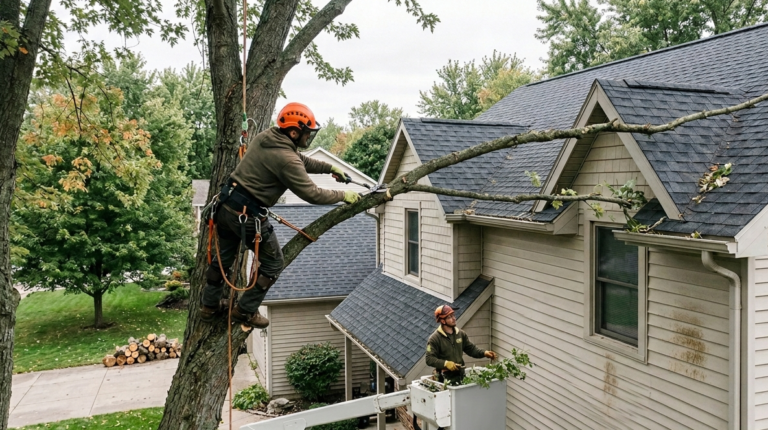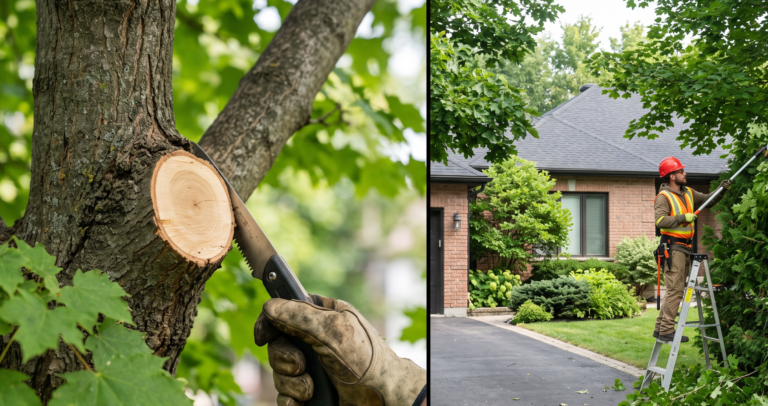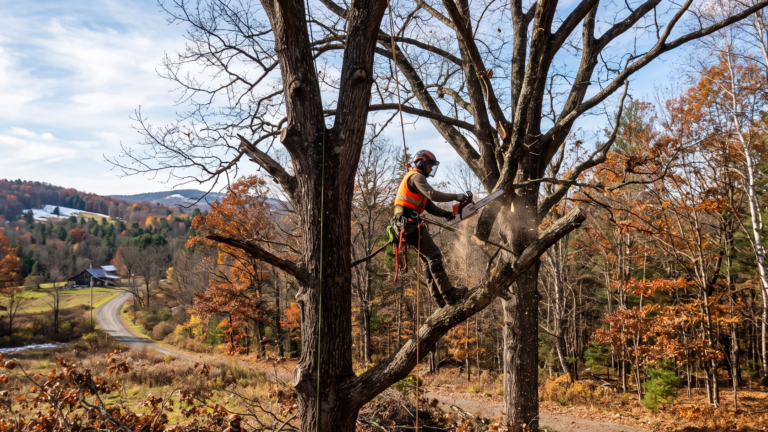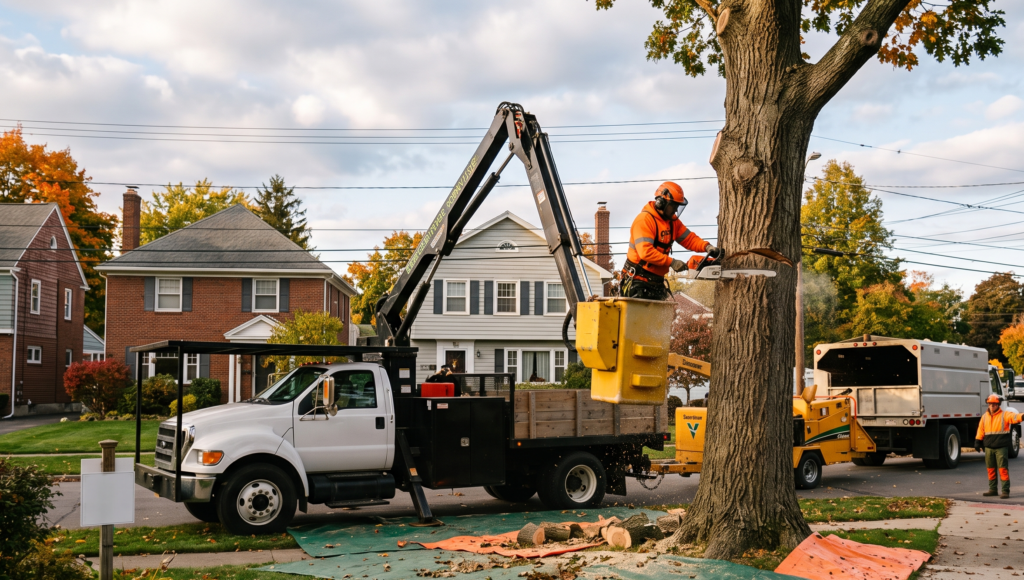
When planning tree removal on your property, one critical question often stands between you and a cleared yard: Do you need a permit to remove a tree in Rochester, NY? In most situations across Monroe County, private residential homeowners do not need a municipal permit to cut down a standard tree located entirely within their surveyed property boundaries. However, local regulations change immediately once that tree touches public rights-of-way, designated preservation corridors, utility easements, or shared property lines. Taking down an aging oak or a storm-damaged spruce without understanding local municipal codes can lead to unexpected stop-work orders, municipal fines, or contentious boundary disputes with neighbors.
Our team at Greece Tree Service breaks down local municipal laws across Rochester, Greece, and Monroe County so you know exactly when you are clear to cut, when a permit is legally mandatory, and how to protect your landscape investment.
The Short Answer: Private vs. Public Land
In the City of Rochester and surrounding Monroe County suburbs (such as Greece, Irondequoit, Webster, Gates, and Chili), tree ordinances distinguish sharply between private property and public easements or right-of-way zones.
- Standard Private Residential Trees: If a tree is rooted squarely inside your surveyed property line and is not subject to a specific neighborhood conservation easement, you generally do not need a permit from the city or town hall to remove it.
- Street Trees & Right-of-Way (ROW): If the tree is situated on the “tree lawn”—the strip of soil between your sidewalk and the street curb—it belongs under the municipal umbrella. You cannot cut, prune roots, or remove a street tree yourself. In Rochester, the City Forestry Division governs these public assets. In suburbs like Greece, the Department of Public Works (DPW) maintains primary jurisdiction.
- Contractor Licensing: Even when a homeowner does not need a permit, the crew doing the cutting often does. For instance, in the Town of Greece, commercial tree care companies must register through the Town of Greece Tree Service Permit Program to legally haul heavy timber and operate commercial equipment on residential streets.
Frequently Asked Questions
Q: How do I find out if a tree is on my land or the town’s right-of-way?
A: Check your property survey map or contact your local municipal engineering department. As a general operational rule across Monroe County, trees growing between the sidewalk and the street curb almost always sit within the public right-of-way easement.
Q: Will the City of Rochester or Town of Greece remove a dead street tree for free?
A: Yes. If a municipal arborist from the city forestry division or suburban DPW verifies that a tree located on the municipal right-of-way is dead, diseased, or structurally hazardous, public crews will schedule and fund the removal at no direct charge to the homeowner.
Q: Does a private homeowner need to verify contractor licensing in Greece, NY?
A: Yes. The Town of Greece mandates an annual operating registry for commercial tree businesses. Hiring an unregistered service provider can result in on-site stop-work citations issued by town code enforcement officers.
When a Tree Removal Permit Is Required in the Greater Rochester Area
While everyday residential yard maintenance usually bypasses the permit desk, distinct legal and environmental exceptions trigger mandatory municipal oversight:
1. The Tree Lawn or Public Right-of-Way
Never fell a tree in front of your home without verifying where your deeded property line ends. The municipal right-of-way often extends several feet beyond the pavement edge. If an ash tree or Norway maple in front of your home is dropping limbs, call 311 (within Rochester) or contact your suburban highway department. The town will inspect the canopy and determine whether municipal crews will take it down at public expense.
2. Designated Historic Districts
If your home is located within one of Rochester’s designated historic preservation districts—such as the East Avenue Historic District, Mount Hope, Grove Place, or Corn Hill—exterior property alterations fall under the jurisdiction of the Rochester Preservation Board. While hazardous or dead trees threatening homes can receive expedited emergency clearance, historic preservation guidelines frequently require advance notification or formal landscape replanting plans before mature canopy trees can be cleared.
3. Wetlands, Ravines, and Waterfront Protection Overlays
Properties backing up to the Genesee River gorge, Irondequoit Bay, Lake Ontario, or state-designated wetlands regulated by the New York State Department of Environmental Conservation (NYS DEC) are governed by strict soil stabilization mandates. Removing extensive root systems on steep embankments can accelerate catastrophic slope failure and bank erosion, making state or town environmental clearing permits mandatory before machinery touches the bank.
4. Commercial Developments and Subdivision Site Plans
If you are clearing multiple mature trees to build a structural addition, erect an outbuilding, or grade an unplatted parcel, the City of Rochester’s Bureau of Zoning and Permitting and suburban planning boards enforce strict site-plan review rules. You must secure an approved soil erosion and tree-clearing permit before breaking ground.
Frequently Asked Questions
Q: Do I need a permit to remove an ash tree killed by the Emerald Ash Borer?
A: On private residential property outside of designated historic or wetland overlay districts, no permit is required. If the ash tree sits on the municipal tree lawn or in a protected environmental corridor, you must notify local forestry or the NYS DEC before any cutting takes place.
Q: What happens if I remove a tree in a Rochester historic district without approval?
A: Unapproved removals in designated historic preservation districts can lead to code violation citations, stop-work orders, and steep administrative fines from the Rochester Preservation Board, along with legal mandates to plant mature replacement trees at the property owner’s expense.
Q: Who do I contact to verify wetland boundaries near Lake Ontario or Irondequoit Bay?
A: Contact the NYS DEC Region 8 office (covering Monroe County) or your local town planning and zoning department to confirm whether your parcel falls within an Environmental Protection Overlay District (EPOD).
Monroe County Boundary Rules: Who Owns That Borderline Tree?
Boundary line disputes represent a major share of tree evaluations across established neighborhoods like Charlotte, North Winton Village, Maplewood, and Barnard.
- The Trunk Rule: Under New York State common law, legal ownership of a tree is determined strictly by where the trunk enters the ground. If the base of the trunk sits entirely on your side of the surveyed boundary line, you own the tree.
- The Shared Boundary Tree: If the trunk straddles the surveyor’s property line, it is classified as a boundary tree owned jointly by both adjoining landowners as tenants in common. You cannot legally fell a boundary tree without your neighbor’s written consent. Cutting it down unilaterally exposes you to property damage claims and triple-damage timber trespass liability under NYS Real Property Actions and Proceedings Law (RPAPL § 861).
- Overhanging Limbs: You have the legal right under NY common law to trim back overhanging branches or encroaching roots up to your exact property line, but only at your own expense—and never in a reckless manner that fatally injures or structurally destabilizes the neighbor’s tree.
Frequently Asked Questions
Q: Can my neighbor stop me from cutting branches that hang over my driveway?
A: No. Under New York State common law, you possess the right of “self-help” to prune back encroaching branches up to the boundary marker, provided you do not trespass onto their land or compromise the tree’s health and structural stability.
Q: If a neighbor’s healthy tree falls onto my property during a Rochester windstorm, who is financially responsible?
A: In New York, storm damage caused by an otherwise healthy tree is classified as an “Act of God.” Your own homeowner’s insurance policy covers the physical damage and debris removal on your parcel, while your neighbor’s policy covers theirs.
Q: What if the neighbor knew the tree was rotted or dead before it collapsed?
A: If you send prior written notice (such as a certified letter accompanied by date-stamped photographs or an arborist inspection report) establishing that their tree was visibly rotten or hazardous, the neighbor can be held legally liable for negligence and property damages.
Seasonal Canopy Hazards: Why Rochester Trees Fail
Monroe County weather subjects urban and suburban canopies to extreme mechanical stress. Heavy lake-effect snow bands off Lake Ontario, saturated spring soils, high-wind squalls, and freezing ice storms repeatedly expose structural defects.
| Common Rochester Species | Primary Structural Vulnerability | Winter & Storm Failure Risk |
| Green & White Ash | Emerald Ash Borer (EAB) vascular destruction | Extreme: Limbs turn glass-brittle and snap under light gusts |
| Silver Maple | Fast growth with weak, codominant “V-crotches” | High: Severe trunk splitting under heavy, wet lake-effect snow |
| Eastern White Pine | Shallow root plates in saturated soils | Moderate to High: Whole-tree windthrow during wet spring thaws |
| Norway Maple | Stem-girdling roots and internal wood rot | Moderate: Sudden, unpredicted branch drops onto driveways and roofs |
If you notice hollow cavities, carpenter ant frass, fungal conks growing near root flares, or soil mounding on the windward side of a trunk after a squall, the tree presents an imminent hazard that demands professional evaluation.
Frequently Asked Questions
Q: What are the primary warning signs that a mature tree is dying internally?
A: Look for crown dieback, large sections of peeling bark with exit holes, clusters of bracket mushrooms growing near the soil line, premature summer leaf loss, and deep vertical seams running along primary branch unions.
Q: Can a tree care crew bypass municipal delays during an active emergency?
A: Yes. If a damaged trunk or split branch poses an immediate hazard to human safety, overhead electrical lines, or structural foundations, certified crews can perform emergency removals immediately across all Monroe County jurisdictions without waiting for routine administrative review.
Q: Why are silver maples so vulnerable during Upstate NY winters?
A: Silver maples grow rapidly and frequently produce multiple competing stems with “included bark” pinched inside the joints. When heavy, moisture-laden lake-effect snow accumulates on the canopy, these structural joints lack the tensile strength to hold the load and shear open.
What to Look for in a Rochester Tree Care Contractor
Tree extraction is among the most dangerous property-service operations in the country. Verifying a contractor’s local credentials safeguards your property, your family, and your legal liability:
- Town Registrations: Ensure your tree contractor maintains current municipal permits, such as the Town of Greece commercial tree service registration.
- Comprehensive Insurance Verification: Demand a Certificate of Insurance (COI) confirming active general liability and statutory NYS workers’ compensation coverage. If an uninsured worker is injured on your property, New York Labor Law can expose the homeowner to personal injury liability.
- ISA Certified Arborists: Contractors with International Society of Arboriculture (ISA) credentials possess the diagnostic skills needed to determine whether an ailing tree can be stabilized through crown reduction or cabling, or must be removed entirely.
- Specialized Rigging Machinery: Established Rochester neighborhoods frequently feature narrow property setbacks and overhead utility drops. Opt for companies equipped with compact articulated lifts, crane-assisted grapples, and heavy-duty turf mats to avoid lawn damage.
Frequently Asked Questions
Q: How do I verify a tree contractor’s New York workers’ compensation coverage?
A: Request a Certificate of Insurance issued directly from their insurance agency showing your name and property address as the certificate holder. The document must reference standard NYS Workers’ Compensation Board forms, such as C-105.2 or U-26.3.
Q: What machinery is best for removing large trees in tight residential lots?
A: Articulated spider lifts and boom cranes enable arborists to dismantle dangerous trees piece-by-piece from overhead, lifting heavy sections clear of rooftops and fences without dropping heavy logs onto your lawn.
Q: Is stump grinding included automatically with tree removal?
A: Stump grinding is typically an optional, separate service line item. Make sure your written proposal states whether grinding depth, root chasing, wood chip backfilling, or lawn repair are included.
Finding a Certified Tree Service Near Me in Rochester & Greece, NY
When a severe wind squall pushes across Lake Ontario or an aging silver maple begins splitting near your foundation, searching for an emergency tree service near me means finding a local crew that can reach your driveway fast with the right rigging equipment.
Headquartered locally in Greece at 91 Mason Ave, Greece Tree Service operates throughout Monroe County with rapid dispatch to all surrounding towns and neighborhoods. Our crews know local utility right-of-way boundaries, town highway regulations, and soil conditions across:
- Greece & Lake Ontario Shoreline: 14612, 14616, 14626 (Braddock Bay, Grandview Beach, Barnard, North Greece, Dewey Ave corridor)
- City of Rochester: 14607, 14609, 14610, 14615, 14620 (Charlotte, Maplewood, North Winton Village, Cobbs Hill, 19th Ward, Highland Park)
- Western & Northern Suburbs: Hilton (14468), Hamlin (14464), Spencerport (14559), Gates (14624), and Irondequoit (14617)
Whether you require crane-assisted tree removal along West Ridge Road (Route 104), preventive crown thinning along Latta Road or Maiden Lane, or 24/7 storm damage clearance, our local specialists deliver safe, fully insured, code-compliant property solutions.
Frequently Asked Questions
Q: How fast can your local crews respond to tree damage in Monroe County?
A: For structural emergencies—such as trees resting against rooflines, broken hanging limbs, or blocked driveways—our Greece-based dispatch team provides same-day priority emergency service across Rochester and Monroe County 24 hours a day, 7 days a week.
Q: Can large equipment reach trees in older Rochester neighborhoods with narrow driveways?
A: Yes. We use low-ground-pressure spider lifts that track through standard 36-inch yard gates. This allows our arborists to access confined backyards in dense neighborhoods like Corn Hill, Maplewood, and the South Wedge without damaging turf, concrete driveways, or underground septic lines.
Protect Your Rochester Property Today
Navigating tree removals shouldn’t mean wrestling with municipal code confusion or second-guessing property lines. Whether you are dealing with a dead ash tree threatening your roof or need an expert health assessment on an overhanging branch, local experience and verified insurance are your greatest assets.
Have a question about a tree on your property? Contact Greece Tree Service today at (585) 628-8744 or visit our office at 91 Mason Ave, Rochester, NY 14626 to schedule an on-site property evaluation with an experienced local tree specialist in Rochester and Greece, NY.